 Seoul Window
Not investment advice
This article explains a social trend in Korea. It is not a recommendation to buy or sell any stock or fund. Prices quoted are past closing levels and change daily.
The short answer
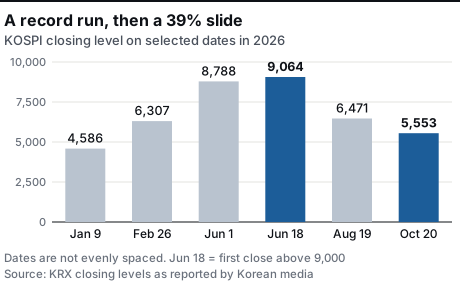
- 2026 turned Korea into a nation of stock watchers. The KOSPI index closed above 9,000 for the first time on June 18, up more than 110% since January, driven by AI demand for memory chips.
- Two stocks did most of the work: Samsung Electronics and SK hynix, nicknamed Samjeon-Nix. Active trading accounts hit 109 million in June, about two per person (Korea Financial Investment Association).
- Then came the slide. By October 20 the KOSPI had closed at 5,552.74, about 39% below its June peak, and retail investors were still buying the dips.
- For visitors, it means stocks are everyday small talk, red means up, and asking how much someone lost is not a great opener.
Ride a Seoul subway this year and count the stock apps. On the screens around you, numbers flash red and blue between Instagram and KakaoTalk. Office workers check prices under the table at lunch, university students compare portfolios in group chats, and Samsung’s share price comes up at family dinners about as often as the weather.
This is a guide to what happened, why it matters so much to Koreans, and the words you need to follow the conversation.
What does "Samjeon-Nix" mean?
삼전닉스 Samjeon-Nix joins Samjeon, the standard abbreviation for Samsung Electronics, with the end of SK hynix. The two companies are the world’s leading makers of memory chips, and AI data centers need enormous amounts of memory, especially high-bandwidth memory (HBM). As chip prices climbed through late 2025 and 2026, so did their earnings forecasts and their share prices.
On June 18, Samsung Electronics closed at a record ₩362,500 and SK hynix at ₩2,685,000. By May, the pair made up about 44% of the whole KOSPI index, so when people in Korea said “the market is up”, they mostly meant two companies. Retail investors piled in: Money Today, citing FnGuide data, reported that individuals bought a net ₩53 trillion of the two stocks in 2026 by the start of June.
How many Koreans actually own stocks?
More than ever. The Korea Financial Investment Association counted 109,006,967 active trading accounts on June 26, 2026, a record. The count first passed 100 million on January 29 and grew by about 18 million in a year. “Active” means an account with at least ₩100,000 in it that has traded at least once in the past six months, so dormant accounts are not included. Many people hold more than one, but even so, it works out to roughly two accounts for every resident.
Cash waiting on the sidelines rose too. Investor deposits at brokerages reached a record ₩108.3 trillion on February 23, up from ₩87.8 trillion at the end of 2025.
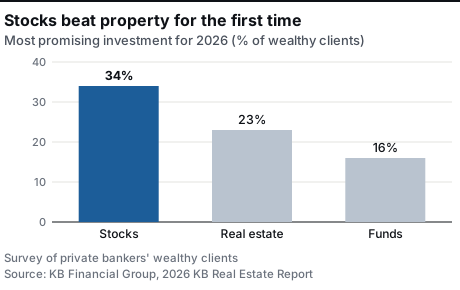
The bigger shift is in what Koreans think wealth is made of. For decades, the answer was an apartment. Even the rich are changing their minds.
If you want the housing side of the story, read how jeonse works and why Seoul apartment prices surged. Wages matter here too: as chipmakers’ profits soared, so did their bonuses, a theme in our chaebol pay ranking.
What stock slang will you hear in Seoul?
Korean investing has its own vocabulary, and most of it is playful. These are the words you will hear most often.
🐜 Korean stock slang, 2026 edition
| Korean | Romanized | Meaning |
|---|---|---|
| 개미 | gaemi | “Ant”: an individual retail investor |
| 동학개미 | donghak gaemi | “Donghak ants”: the retail wave that buys Korean stocks when foreigners sell, named after the 1894 Donghak peasant uprising |
| 서학개미 | seohak gaemi | “Western-learning ants”: retail investors in US stocks |
| 국장 / 미장 | gukjang / mijang | The Korean market / the US market |
| 삼전닉스 | Samjeon-Nix | Samsung Electronics and SK hynix as a pair |
| 구천피 | gucheonpi | “KOSPI 9,000” (6,000 is yukcheonpi, and so on) |
| 포모 | pomo | FOMO, the fear of missing out on the rally |
| 빚투 | bittu | Borrowing money to invest |
| 존버 | jonbeo | Holding on stubbornly through losses |
| 물타기 | multagi | “Adding water”: buying more as the price falls to lower your average cost |
| 떡상 / 떡락 | tteoksang / tteongnak | A price skyrocketing / crashing |
Slang changes fast; our MZ slang guide covers the non-financial side.
Red means up
On Korean stock apps, TV tickers and bank-lobby screens, red is a rise and blue is a fall. That is the opposite of most American and European apps, and it trips up visitors constantly. A Korean friend celebrating a "red day" is having a good one.
Why did the rally turn into a slide?
The same concentration that drove the rise drove the fall. According to Newstown, the KOSPI fell about 22% in July and another 17% in the first half of October, leaving it about 39% below its June peak by October 20. The main reasons reported:
- Two-stock dependence. Samsung Electronics and SK hynix fell about 20% and 28% between October 1 and 16, dragging the index with them.
- Doubts about AI spending. Bond prices of US cloud company CoreWeave dropped, raising worries about how AI data centers are being financed.
- Inflation and foreign selling. On October 15, a hotter-than-expected US inflation reading sent the KOSPI down 7.57% in a day, to 5,554.22, its seventh straight decline on foreign selling.
- Borrowed money. Margin loans peaked at ₩38.63 trillion on June 24. As prices fell, forced liquidations topped ₩50 billion a day for four straight sessions to October 16.
Through it all, the ants kept buying. On October 20, Hankyung reported, foreigners sold a net ₩830.2 billion of KOSPI stocks and institutions ₩1.31 trillion, while individuals bought a net ₩1.52 trillion. Some have started to spread out, too: Financial News found that by August, retail buying had shifted partly toward power, shipbuilding and financial stocks such as KEPCO, Doosan Enerbility and KB Financial.
What does this mean for visitors?
- It is safe small talk, up to a point. “Do you invest?” is a normal question among friends and coworkers in Korea. “How much did you lose?” is not.
- The won moved too. The won strengthened through the summer; on October 20 it traded at ₩1,328.1 per dollar. If you are budgeting a trip, our won exchange rate guide has the context.
- Market hours set the rhythm. The Korea Exchange’s regular session runs 9:00 a.m. to 3:30 p.m. KST on weekdays, and daily price moves for an individual stock are capped at ±30%. That is why office chatter peaks right after 9 and after 3:30.
- Samsung is everywhere. The company whose share price everyone watches also makes the phone in many visitors’ pockets. Our guide to Samsung family brands shows how far its empire reaches.
Want more numbers on Korean life? See how much Koreans earn in 2026.
Sources
- Hankyung — Active accounts hit 109 million (Korea Financial Investment Association data, June 2026)
- Herald Corporation — Investor deposits and accounts at record highs (February 2026)
- Seoul Shinmun — KOSPI closes above 9,000 (June 18, 2026)
- Money Today — Retail net buying of Samsung Electronics and SK hynix (June 2026)
- Hankyung — 2026 KB Real Estate Report: stocks top the list
- Newstown — KOSPI's 2026 gains shrink from 116% to 31% (October 2026)
- Hankyung — Why the KOSPI fell on October 20, 2026
- Financial News — Retail investors look beyond chips (August 2026)
- KOSPI closing levels in the chart: SBS Biz (Jan 9), Money Today (Feb 26), MTN (Jun 1), Seoul Shinmun (Jun 18), Financial News (Aug 19), Money Today (Oct 20)