 Seoul Window
The short answer
- Even without insurance, a basic visit (exam + X-ray + scaling) at a neighborhood clinic is about ₩100,000 — based on ESarang Dental Clinic's September 2026 price list
- The bigger the treatment — implants, crowns, clear aligners — the wider the price gap with the US and Australia
- Most dentists work in small neighborhood clinics, so there's almost always one nearby, often same-day
- The twist: Koreans find the dentist expensive too — dental clinics are covered at just 35.7% by national insurance, about half the overall 64.9%
- Need somewhere easy? The editor's long-time dentist, ESarang Dental Clinic at Gongdeok Station (English spoken, not an ad)
Live in Seoul long enough and you’ll hear the same question from friends abroad: “I heard dentists in Korea are cheap. Is that true?” Followed right away by: “Okay, but how do I book? Do they speak English?”
The honest answer is “mostly yes, especially for big treatments” — with a few catches. This guide starts from one price list on the front desk of ESarang Dental Clinic in Gongdeok, where the editor has been a patient for years, and works outward: why Korean dentists are close, fast and (relatively) affordable, and why Koreans themselves still dread the bill. If you want a deep dive into implant and braces pricing, that lives in our Korea implant and braces cost guide. This one is about how a foreigner can actually use a Korean dentist.
What Does a Neighborhood Dentist in Seoul Actually Charge?
This is the price list sitting on the front desk of ESarang Dental Clinic, a neighborhood practice right by Gongdeok Station (prices as of September 2026; the clinic is introduced at the end). Korean medical institutions are required to display prices for non-covered (uninsured) services, which is why most dentists keep a sheet like this at reception, on the wall or on their website.
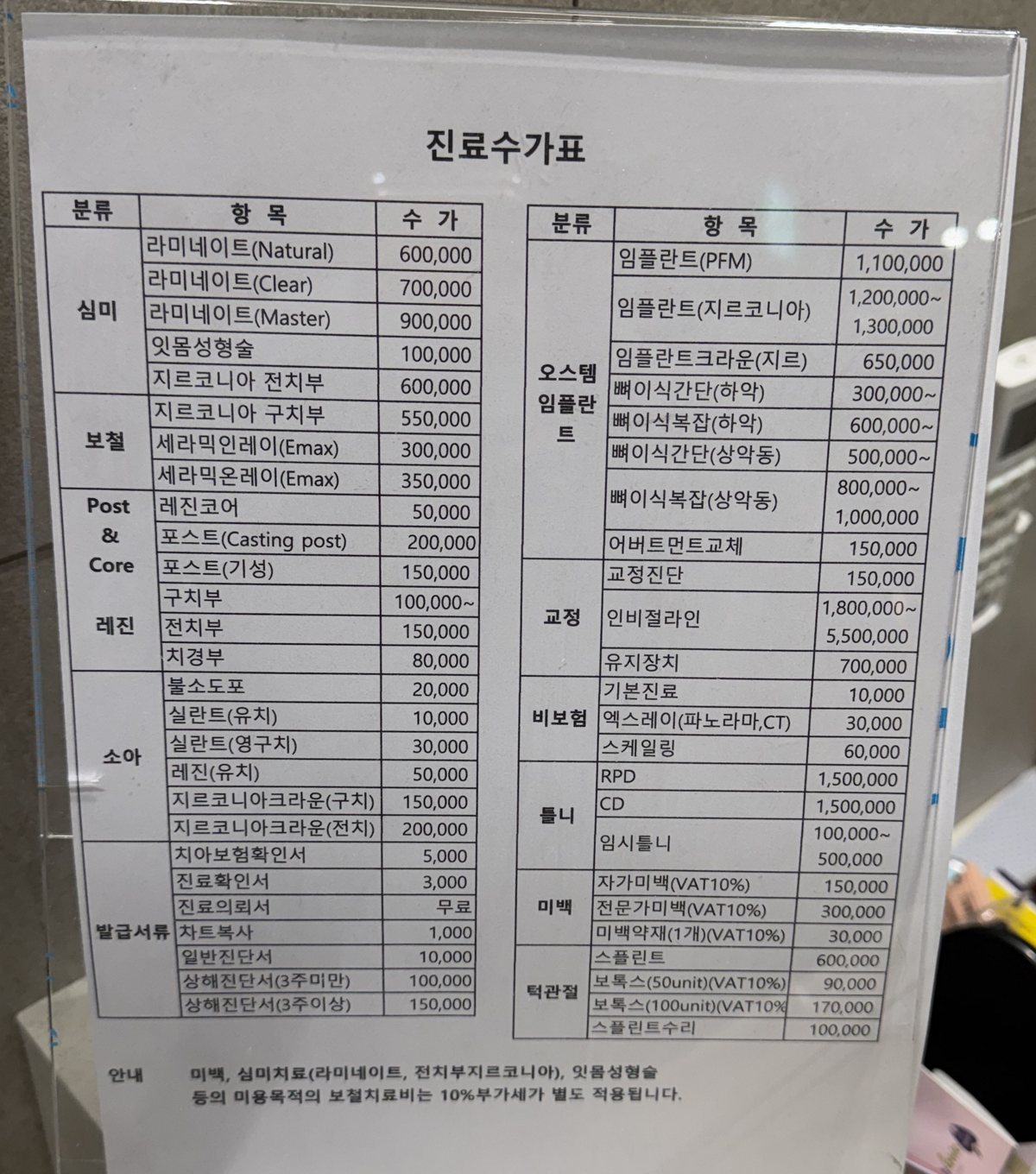
Here are the items foreigners ask about most. Dollar figures are rough conversions at the Seoul FX market close on September 28, 2026 (US$1 = ₩1,365).
🦷 ESarang Dental Clinic price list — items foreigners ask about most (uninsured prices, Sept 2026)
| Item | Price | Approx. USD | Notes |
|---|---|---|---|
| Basic consultation (uninsured) | ₩10,000 | $7 | For patients without Korean insurance |
| X-ray (panoramic / CT) | ₩30,000 | $22 | Usually taken on the spot, in-clinic |
| Scaling (uninsured) | ₩60,000 | $44 | Insured residents get one covered scaling a year |
| Resin filling — back tooth | from ₩100,000 | from $73 | Tooth-colored filling |
| Resin filling — front tooth | ₩150,000 | $110 | |
| Ceramic inlay (E.max) | ₩300,000 | $220 | Partial cap |
| Zirconia crown — back tooth | ₩550,000 | $403 | Full cap |
| Implant (Osstem, PFM) | ₩1,100,000 | $806 | |
| Implant (Osstem, zirconia) | ₩1,200,000–1,300,000 | $879–952 | |
| Invisalign (clear aligners) | ₩1,800,000–5,500,000 | $1,319–4,029 | Depends on difficulty and length |
| In-office whitening | ₩300,000 + VAT | $220 + VAT | Cosmetic work adds 10% VAT |
| TMJ Botox, 50 units | ₩90,000 + VAT | $66 + VAT | Common for teeth grinders |
| Treatment confirmation / medical certificate | ₩3,000 / ₩10,000 | $2 / $7 | For travel insurance claims |
And this clinic isn’t unusually cheap. In the 2025 non-covered fee data published by the Health Insurance Review & Assessment Service (HIRA), the median price of one implant at a dental clinic was ₩1,200,000 — right where this list sits. In other words, this is pretty much what an ordinary Seoul neighborhood dentist charges. How to check local prices on HIRA’s database is explained in our implant and braces cost guide.
The fine print: 10% VAT
At the bottom of the list is a note: whitening, cosmetic work (veneers, front-tooth zirconia) and gum contouring carry an extra 10% VAT. In Korea, treatment for medical reasons is VAT-exempt, but cosmetic procedures are not. When you get a quote for veneers or whitening, ask whether it's VAT 포함 (VAT included).
Is Dental Care in Korea Really Cheaper Than at Home?
Insurance systems and price disclosure differ so much between countries that a perfect comparison is impossible. Line up each country’s published figures, though, and the pattern is clear. All won conversions use the Seoul FX market close on September 28, 2026 (US$1 = ₩1,365, A$1 = ₩958, ¥100 = ₩866, £1 = ₩1,806).
🌏 One implant, full self-pay price
| Country | Published price | In won | Basis |
|---|---|---|---|
| Korea | ₩1,100,000–1,300,000 | — | ESarang Dental Clinic price list (Sept 2026) |
| Korea (national clinic median) | ₩1,200,000 | — | HIRA 2025 non-covered fee data |
| United States | avg. $2,143 + crown $488–3,254 extra | approx. ₩2.93M + ₩0.67M–4.44M | 2024 procedure cost study cited by CareCredit |
| Australia | A$3,500–6,000 (crown included) | approx. ₩3.35M–5.75M | 25th–75th percentile, based on the ADA fee survey |
| Japan | ¥300,000–500,000 (self-pay) | approx. ₩2.60M–4.33M | Typical range quoted by Japanese clinics |
🪥 Routine care — Korea uninsured vs Australia vs NHS England
| Item | Korea (uninsured, price list) | Australia (fee survey, 25th–75th pct.) | NHS England flat charge |
|---|---|---|---|
| Exam, X-ray, scaling | ₩100,000 | A$280–480 (approx. ₩270,000–460,000) | Band 1 £27.90 (approx. ₩50,000) |
| One resin filling | from ₩100,000 (back tooth) | A$150–260 (approx. ₩140,000–250,000) | Band 2 £76.60 (approx. ₩140,000, whole course) |
| One crown | ₩550,000 (zirconia) | A$1,500–2,500 (approx. ₩1.44M–2.40M) | Band 3 £332.10 (approx. ₩600,000, whole course) |
| Clear aligners | ₩1,800,000–5,500,000 | A$6,500–9,000 (approx. ₩6.23M–8.62M) | Adults generally not eligible on the NHS |
Three things jump out.
- The bigger the job, the bigger the gap. An implant in Korea costs roughly one-half to one-fifth of what it does in the US, Australia or Japan. A crown is about a third of the Australian price, and aligners come in clearly below the Australian range.
- Where public dental care is strong, routine visits can be cheaper than Korea's uninsured rate. NHS England's flat charges and Japan's insured care (30% copay) beat Korea's uninsured prices for basics. The catch in the UK is getting an appointment at all: patient watchdog Healthwatch said the 2025 GP Patient Survey showed about one in five people unable to get an NHS dental appointment.
- If you're coming from Vietnam, Indonesia or similar markets, Korea won't always be cheaper. Its real edge isn't only price — it's the access and speed explained below.
💡 Planning an implant on a trip?
An implant needs months to fuse with the bone, so it takes at least two visits. On a short trip, realistically you can finish a check-up, scaling, resin fillings, extractions or whitening. For timelines, see the [implant and braces cost guide](/en/guides/korea-dental-implant-braces-cost/).
Does Korea Have a Lot of Dentists for Its Population?
Surprisingly, not if you count dentists. According to the Korean Dental Association’s policy research institute, Korea had 0.51 practicing dentists per 1,000 people in 2019, below the OECD average of 0.7. The number is growing fast, though — among the fastest in the OECD — and HIRA’s figures put it at 5.63 per 10,000 people (about 0.56 per 1,000) in 2024.
So why does Seoul feel like it has a dentist on every corner? Because of how Korean dentists work.
Close to 99% of Korean dental practices are small clinics run by one or two dentists. Patients aren’t funneled into big hospital departments; instead there’s a little clinic in every apartment-complex arcade, on the second floor above the station, next to every subway exit. Seoul also has the highest dentist density in the country.
ℹ️ Lots of clinics = fierce competition
According to the industry's annual yearbook, 702 dental clinics opened and 590 closed in 2024 alone. That competition is why evening hours, Saturday hours, English websites and Naver or KakaoTalk booking have spread even to small neighborhood practices — good news for foreigners. The flip side is that heated competition can raise worries about overtreatment, which we cover below.
Can You See a Dentist in Korea Without an Appointment?
For light care, usually yes. Korean neighborhood clinics are used to patients who drop in with “my tooth’s been a bit sensitive.” In the editor’s experience, check-ups, pain assessments, scaling and small resin fillings are often done as same-day walk-ins. Waiting weeks, as in the UK, or booking a first visit far in advance, as in the US, is rare.
That said, most clinics have a single dentist, so you can wait a long time if booked patients are stacked up. The realistic routine:
- Search "치과" (dentist) in Naver Map → sort by open now and distance, and check review photos for the vibe
- If Naver booking or a KakaoTalk channel is open, grab an empty slot directly
- In a hurry, just call: "Is it possible to come in today?" — or in Korean, "오늘 진료 가능할까요?"
- Bring your passport (residents: your residence card) — needed for check-in and insurance
- Foreign cards are accepted almost everywhere; ask on the spot for the receipt, itemized bill and treatment confirmation you'll need for travel insurance
💡 Toothache on a Sunday or public holiday?
Most neighborhood clinics close on Sundays and public holidays. Use the Ministry of Health and Welfare's E-Gen "open clinics" search (Korean only) and pick 치과 (dentistry) as the department. For interpretation help, call the Korea Tourism Organization's travel hotline 1330 (24 hours); for serious swelling or fever, call 119. For painkillers, see our [late-night pharmacy guide](/en/guides/korea-late-night-pharmacy-hours/).
Why one clinic can handle almost everything
Another reason Korean neighborhood dentists are easy: you almost never hear “go get an X-ray somewhere else and come back.”
- Panoramic X-rays and CT scans are taken in-house, then explained on a monitor right in front of you (₩30,000 uninsured on this price list)
- Scaling, fillings, root canals and extractions are normally handled by the same clinic and the same dentist
- TMJ Botox, night splints and whitening — things that might send you to a separate specialist elsewhere — are on a neighborhood dentist's menu
- Medical certificates, treatment confirmations and chart copies are issued at the front desk on the spot, which makes travel-insurance claims easy (ask separately whether English documents are available and what they cost)
Why Do Koreans Find the Dentist So Expensive?
It may look cheap to visitors, but Koreans think of the dentist as a place where big money goes. The reason is simple: dentistry is the least-insured field in Korean medicine.
Insurance covers the basics: drilling out decay and filling with standard material, root canals, extractions, gum treatment and one scaling a year. What people actually get a lot of — adult resin fillings, inlays, crowns, orthodontics, whitening and veneers — is mostly uninsured, and implants and dentures are covered only from age 65. According to the Korean Dental Association’s yearbook (as reported by trade media), patients and households paid about ₩8.3 trillion of the roughly ₩13 trillion spent on outpatient dental care in 2023.
That’s why Koreans buy separate private dental insurance (치아보험, “tooth insurance”), and why this price list even has a fee for a dental-insurance claim form.
💡 Living in Korea for six months or more?
Registered foreign residents who stay six months or longer are enrolled in National Health Insurance and get the same dental coverage as Koreans. From age 19, you get one insured scaling per calendar year (January 1 to December 31) — so fit one in before year-end. The ₩60,000 uninsured cleaning costs far less out of pocket with insurance. Eligibility and premiums are covered in our [health insurance guide for foreigners](/en/guides/korea-health-insurance-foreigners-nhis/).
How Do You Avoid Overtreatment at a Korean Dentist?
With so many clinics and so much uninsured work, even Koreans joke that “every dentist finds a different number of cavities.” Foreigners aren’t singled out, but when communication is shaky it’s natural to worry that treatment will grow without explanation. Keep a few habits:
- Ask to see the X-ray. Pointing out on screen which tooth has what problem is standard practice in Korea
- Ask "Does this need to be done now, or can we monitor it?" A good dentist separates the urgent from the optional
- Get an itemized quote in writing — material (resin / inlay / crown), number of teeth and whether VAT is included
- For major work, a second opinion is completely normal in Korea too. Nobody considers it rude to get checked at another clinic
- To check whether a price is fair, search local clinic prices on HIRA's non-covered fee portal
An English-Speaking Dentist in Gongdeok: ESarang Dental Clinic
Finally, when foreign friends ask, “So where should I actually go?”, here’s the place the editor genuinely recommends: ESarang Dental Clinic (이사랑치과), right by Gongdeok Station in Mapo-gu.
ℹ️ Full disclosure
This recommendation is completely unpaid. There is no sponsorship, discount or advertising deal of any kind. The editor has been a patient here for a long time and simply wants foreign friends to have a good place to go when they need a dentist.
Why the editor keeps going back is simple.
- No overtreatment — the thing that stands out most after years as a patient. They recommend only what you need and explain it properly
- English is spoken — the clinic runs an English website and welcomes foreign patients
- Everything a neighborhood clinic should have — the head dentist, Dr. Joon Hee Park, is a board-certified specialist in prosthodontics and advanced general dentistry, covering everything from general care to implants, Invisalign, veneers and TMJ treatment
- Easy to reach — Gongdeok Station is where Lines 5 and 6, the Gyeongui–Jungang Line and AREX (Airport Railroad) meet, so it's simple to get to from Incheon Airport, Hongdae or Yeouido
📍 ESarang Dental Clinic at a glance (as of September 2026)
| Item | Details |
|---|---|
| Location | 1F, Bldg 105, Pentraus shopping arcade, 205 Baekbeom-ro, Mapo-gu, Seoul (about 2 min from Gongdeok Station Exit 6) |
| Head dentist | Dr. Joon Hee Park (board-certified in prosthodontics and advanced general dentistry) |
| Hours | Mon, Wed, Fri 9:30–18:30 / Tue 9:30–20:30 (late) / Sat 9:30–14:00 |
| Lunch break | 13:00–14:00 (no lunch break on Saturday) |
| Closed | Thursdays, Sundays and public holidays |
| Booking | Naver booking, KakaoTalk channel, phone 02-701-2199 |
| Languages | Korean, English |
| Parking | Pentraus west-gate outdoor lot, 2 hours free |
Hours can change, so confirm by Naver booking or phone before you go. The English website is esarangdental.com/en.
Sources
- Price list: posted at the front desk of ESarang Dental Clinic (Gongdeok, Mapo-gu, Seoul), prices as of September 2026 (photo by the editor)
- National Health Insurance Service, 2024 Survey of Medical Expenses for Health Insurance Patients, press release (Dec 30, 2025) — press release PDF (as posted by the Korea Insurance Research Institute), Dental News report
- National Health Insurance Service webzine, coverage rules for scaling and dentures for seniors
- HIRA analysis (Dec 3, 2025) of dentists per 10,000 people — Daily Dental report
- KDA Dental Healthcare Policy Research Institute, OECD comparison of practicing dentists per 1,000 people — Daily Dental report
- KDA Dental Healthcare Policy Research Institute, 2024 Korean Dental Care Yearbook (clinic counts, openings and closures, outpatient dental spending) — Dental Arirang report
- NHS, How much will I pay for NHS dental treatment?
- Healthwatch, Our response to GP Patient Survey 2025
- CareCredit, Dental implants cost (citing the 2024 Synchrony procedure cost study)
- Compare Dentists, Dental procedure costs in Australia (based on the ADA fee survey)
- Self-pay implant prices in Japan: Nihonbashi Dental Clinic and other Japanese clinic price guides
- Exchange rates: Seoul FX market close, September 28, 2026 — PPSS report
- Ministry of Health and Welfare E-Gen emergency medical portal / ESarang Dental Clinic official website