 Seoul Window
The short answer
- From November to March, the Han River in Seoul fills with wintering ducks, cormorants and raptors such as the white-tailed eagle. Watching them costs nothing.
- Easiest start: Gangseo Wetland Ecological Park (Line 5 Banghwa Station + village bus Gangseo 07). It has a two-storey observatory with telescopes.
- Three more: the Bamseom observatory in Yeouido (open December to February), mandarin ducks on Jungnangcheon, and Amsa and Godeok eco parks in the east.
- Don't feed the birds, stay on the paths and leave the drone at home. Bird flu can close sites at short notice, so check before you go.
Walk along the Han River in January and the water looks empty until you stop and actually look. Then you notice the rafts of diving ducks, the cormorants drying their wings on Bamseom’s trees, and every so often something much bigger circling overhead.
Birdwatching has quietly become a thing in Seoul, and a lot of the new birders are under 35. Here’s what’s behind it, where to go, and how to get there by subway.
Why are young Koreans suddenly into birdwatching?
Because it works like collecting. The Korean word is 탐조 (tamjo, literally “searching for birds”), and for a lot of people in their 20s and 30s it feels less like a quiet nature walk and more like filling in a Pokédex. You never know which species will show up, and each new one goes on the list.
The same article described a small birding brand, Chichi-chit (치치-칫), whose goods sold out early at the DMZ Peace Train Music Festival in Cheorwon in June, and university birding clubs such as Ewha’s Saerang and Sahmyook’s Hovering. The barrier to entry is low: Hankyung put an entry-level pair of binoculars at around ₩100,000, and many guided programs are free.
Two free apps worth installing
- Merlin Bird ID (Cornell Lab of Ornithology): free, and Korea is one of its downloadable bird pack regions. Point it at a photo or let it listen to a call.
- eBird (also Cornell Lab): log what you saw as a checklist and see what others have recorded at the same spot recently.
Where can you see migratory birds in Seoul in winter?
Four free spots along the Han River cover most of what you’d want to see, from Gangseo in the far west to Amsa in the east. The sketch below shows roughly where they sit and which station to use. It is a wayfinding diagram, not a scale map.
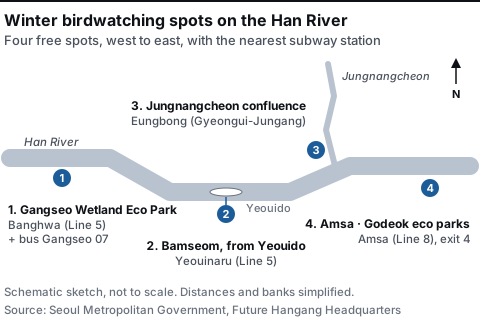
🦆 Han River winter birdwatching spots (as of October 2026)
| Spot | Best for | Nearest station | How to get there | Facilities |
|---|---|---|---|---|
| Gangseo Wetland Ecological Park | First-timers, diving ducks, raptors | Banghwa (Line 5) | Exit 2, village bus Gangseo 07 to the last stop | Two-storey observatory with telescopes, ~2 km trail, no lighting |
| Bamseom (from Yeouido Hangang Park) | Cormorant roost, white-tailed eagle | Yeouinaru (Line 5) | Exit 2 or 3 into Yeouido Hangang Park, south edge of the Neoreun Madang lawn | Observatory open December to February, free |
| Jungnangcheon confluence | Mandarin ducks up close | Eungbong (Gyeongui-Jungang Line) | Walk along the stream toward Yongbi and Seongdong bridges | Riverside paths, telescopes along the stream |
| Amsa & Godeok eco parks | Whooper swans, raptors (with luck) | Amsa (Line 8) | Exit 4, about 5 minutes on foot via the Amsa underpass | Han River viewing decks, Godeok bird observation post |
1. Gangseo Wetland Ecological Park — the best first stop
Inside Gangseo Hangang Park between Banghwa Bridge and Haengju Bridge, this 370,000 m² wetland opened in 2002 and was designated an ecological and landscape conservation area in 2024. Seoul’s official news site says wintering birds stay here from November through March.
The reason to come is the two-storey bird observatory, reached through a path between bamboo fences, with mounted telescopes looking out over the river. The trail runs about 2 km along the water, flat enough for strollers. Common pochards form the biggest flocks; coots, great cormorants, little grebes and white-fronted geese turn up too, and kestrels, long-eared owls and buzzards hunt over the reeds.
There is no lighting in the park, on purpose, for the nocturnal animals. You can walk in freely until sunset, so a winter visit means going by early afternoon at the latest. The wider Gangseo Hangang Park has restrooms, a convenience store and a parking lot.
2. Bamseom — a Ramsar wetland you watch from across the water
Bamseom, the island under Seogang Bridge, was Seoul’s first ecological and landscape conservation area (1999) and became the city’s first Ramsar wetland in 2012. Seoul counts about 40 bird species and some 10,000 individuals there. You cannot land on it; access is limited to researchers and cleanup crews.
In winter, great cormorants roost on the island in such numbers that their droppings whiten the trees, and white-tailed eagles and goosanders turn up too. The city runs the Yeouido Bamseom bird observatory at the south edge of the Neoreun Madang lawn in Yeouido Hangang Park, December to February only, free of charge. The official page does not list opening hours, so treat it as a daytime stop.
3. Jungnangcheon confluence — Seoul's mandarin duck stretch
The lower Jungnangcheon, where it meets Cheonggyecheon and then the Han, has been a designated migratory bird protection area since 2005. A monument at the Yongbi rest area marks it.
This is where 원앙 mandarin ducks, a Korean Natural Monument, gather in winter. A Seoul city reporter who walked it in January 2024 started from Eungbong Station and found them resting on rocks under Yongbi Bridge and crowding under Seongdong Bridge, with telescopes installed along the stream for watching from a distance. Seongdong-gu even held a mandarin duck festival at nearby Salgotgi Sports Park in December 2025; dates for 2026 had not been announced as of October 2026.
4. Amsa and Godeok eco parks — the wild east end
At the eastern edge of the city, inside Gwangnaru Hangang Park, two conservation areas sit side by side. Amsa Ecological Park is about a 5-minute walk from Amsa Station exit 4 (Line 8), past the Amsa underpass. Seoul has recorded 29 bird species there, including sparrowhawks, kestrels and buzzards, and lists whooper swans and otters among its residents.
A riverside path of about 2.5 km runs upstream under Guri-Amsa Bridge to Godeok Waterside Ecological Park, which has a bird observation post with a viewing window over the river. Back in 2010, Seoul named this stretch the best place on the Han for raptors, white-tailed eagles included, with the honest caveat that you need luck to see them.
📍 Open in Naver Map — Amsa 📍 Open in Naver Map — Godeok
Can you join a guided birdwatching program?
Yes, and most are free, but they are in Korean and you book them through Seoul’s public reservation site, yeyak.seoul.go.kr. Places go fast.
- Hangang Wild Exploration Center (Nanji, in front of Nanji Camping Ground): free, and it lends telescopes on its tours. In winter 2024 it ran a four-hour bird monitoring walk through Gangseo and Nanji for adults. Search “한강야생” in the education category; booking opened a month ahead.
- Bamseom Hangang Winter Bird School: in the 2024–25 season it ran on Sunday afternoons from December to February for families, free, with experts and field scopes. Whether it runs in 2026–27 had not been announced as of October 2026, so search “밤섬” on yeyak.
- The Bamseom Ecological Experience Center on Mapo Bridge opens April to October only, so it’s not a winter option.
What birds will you actually see?
Mostly ducks, cormorants and gulls, with a real chance of a raptor. The Korean names help, because park signs and Korean birders use them.
🔭 Winter birds named in Seoul's own descriptions of these sites
| Bird | Korean name | Where to look |
|---|---|---|
| White-tailed eagle | 흰꼬리수리 | Bamseom in winter; Amsa side with luck |
| Great cormorant | 민물가마우지 | Roosting on Bamseom; also at Gangseo |
| Common pochard | 흰죽지 | Gangseo, the most numerous flock |
| Mandarin duck | 원앙 | Jungnangcheon, under Yongbi and Seongdong bridges |
| Whooper swan | 큰고니 | Amsa |
| Goosander | 비오리 | Bamseom |
| Eastern buzzard | 말똥가리 | Gangseo, Amsa, Godeok |
| Eurasian coot | 물닭 | Gangseo |
If you only see one of these, make it the cormorants on Bamseom. They are reliable, and the sight of a whole island’s trees gone white in the middle of a city of millions is strange enough to be worth the trip. For the bigger picture of what else lives here, see our guide to Seoul’s wild animals.
How do you watch birds without disturbing them?
Keep your distance, keep quiet and keep your snacks to yourself. A few rules, some of them backed by fines:
Birding etiquette on the Han
- Don't feed them. Seoul asks visitors not to feed wild birds, and signs at mandarin duck sites say the same.
- Stay on the trails. Amsa, Godeok and Bamseom are conservation areas; harming or capturing wildlife there can bring a fine of up to ₩10 million.
- No drones. Almost all of Seoul's airspace needs approval anyway. See drone rules in Korea.
- Be quiet and slow. Use the observatory telescopes or binoculars rather than walking closer.
- Dress for wind. Riverbanks are colder than the city streets. Our Seoul winter survival guide covers layers and heat packs.
Bird flu can close things
When highly pathogenic avian influenza hit in January 2014, Seoul temporarily closed Gangseo's bird observatory and suspended outdoor birdwatching programs at eight Han River eco sites. If there is an outbreak this winter, expect similar closures. Check the Future Hangang Headquarters site or call 120 before a long trip out.
If the weather turns brutal, our indoor Seoul guide has a plan B. For the parks themselves, compare them in the 11 Hangang Parks compared, or follow the tributaries in our neighborhood stream guide. Seoul parks by season shows what else is worth a walk in winter.
Sources
- Hankyung — Why 2030s are hooked on birdwatching (June 25, 2026)
- Seoul Metropolitan Government — Gangseo Wetland Ecological Park, from migratory to resident birds (January 13, 2026)
- Seoul Metropolitan Government — Gangseo Hangang Park and wetland access (May 11, 2026)
- Future Hangang Headquarters — Gangseo Hangang Park facilities
- Future Hangang Headquarters — Bamseom conservation area and observatory
- Seoul Metropolitan Government — Bamseom Hangang Winter Bird School (December 2024)
- Future Hangang Headquarters — Bamseom Ecological Experience Center program (2026)
- Seoul Metropolitan Government — Mandarin ducks on Jungnangcheon (January 25, 2024)
- Seoul Metropolitan Government — Jungnangcheon migratory bird protection area (2010)
- TWIG24 — Seongdong mandarin duck festival (December 11, 2025)
- Future Hangang Headquarters — Amsa-dong conservation area and Godeok-dong conservation area
- Seoul Metropolitan Government — Amsa Ecological Park (September 11, 2025) and Godeok to Amsa walk (October 15, 2021)
- Seoul Metropolitan Government — Natural Monument birds on the Han River (2010)
- Seoul Metropolitan Government — Hangang Wild Exploration Center in winter (January 8, 2025)
- Future Hangang Headquarters — Ecology facilities and program booking
- Seoul Metropolitan Government — Avian influenza measures in Han River parks (January 24, 2014)
- Merlin Bird ID (Google Play) and About eBird