Step into a Korean convenience store for the first time and you’ll notice an entire fridge door dedicated to water. Clear bottles with no labels, blue caps, green caps, a ₩500 one sitting next to a ₩1,000 one — at a glance, they all look identical. But Koreans barely hesitate in front of that fridge. They already know what they’re reaching for. What follows isn’t a tourist-friendly recommendation list — it’s the actual market share, revenue, and pricing data behind the bottled water brands Koreans really grab, and why.
The Short Answer
- The undisputed number one is Jeju Samdasoo — market share 40%, 28 straight years at the top. Four out of every ten Koreans drink this.
- Number two Icis (Lotte Chilsung, ~13%), number three Baeksansu (Nongshim, ~8%). These three alone command 60% of the market.
- But here's the twist: in 2025, all three top brands saw their revenue shrink — cheap private-label water is shaking up the whole game.
- Choose by price and channel, not by taste. The exact same water can cost 1.6 to 2.4 times more at a convenience store than at a supermarket.
What’s the state of Korea’s bottled water market right now?
It’s a massive market, topping ₩3 trillion — but 2025 was the first year the reigning champion actually stumbled. According to Euromonitor, Korea’s bottled water market hit ₩3.1761 trillion in 2024, up 15.6% from the previous year (₩2.7483 trillion) — an all-time high. That’s more than five times the roughly ₩600 billion market of 2014. Rising single-person households, health-conscious consumption, and the normalization of online grocery delivery have all fueled the growth.
But while the market itself kept expanding, the top three brands actually moved backward.
Kwangdong Pharmaceutical disclosed Jeju Samdasoo’s 2025 revenue at ₩318.3 billion, down 0.4% year-on-year. It’s the first revenue decline in 12 years, ever since Kwangdong took over distribution in 2013. Number-two Lotte Chilsung’s drinking water revenue also fell 7.8% to ₩213.7 billion, and Yanbian Nongshim (which produces Baeksansu) saw revenue plunge 28.1% to ₩44 billion. The market is growing, but the dominant players are losing ground — and the ones filling that gap are the private-label waters from convenience stores and supermarkets.
Top 8 Bottled Water Brands Koreans Actually Buy
When Koreans pick a water brand, they look at three things: how familiar is it (brand), how cheap is it (price), and does the taste feel neutral or heavy (hardness). The top five below are the brands that passed all three tests.
🏆 Korea Bottled Water Brand Rankings, August 2026 (Market Share + Brand Reputation Combined)
| # | Brand | Manufacturer / Distributor | Water Source | Local Insight |
|---|---|---|---|---|
| 1 | Jeju Samdasoo | Jeju Development Corp. / Kwangdong Pharmaceutical | Jeju volcanic bedrock aquifer | ~40% share, 28 straight years at #1. July 2026 brand reputation index: 1.59 million — a 4x lead over #2 |
| 2 | Icis | Lotte Chilsung Beverage | Sunchang, Cheongdo, Cheongju, Yeoncheon, etc. | ~13% share. First label-free bottled water in Korea (2020); 9.4 g ultra-lightweight PET bottle (2024) |
| 3 | Baeksansu | Nongshim | Changbai Mountain National Nature Reserve (Baekdusan) | ~8% share. Cumulative sales surpassed ₩1.1 trillion by 2025. Brand reputation jumped +66% in 2026 |
| 4 | Sparkle | Sparkle Co., Ltd. | Four sites: Cheonan, Ulju, Gongju, Pocheon | Founded 1983. Dominates home-delivery water; consistently ranks high in brand reputation |
| 5 | Dongwon Spring Water | Dongwon F&B | Multiple plants | Strong in supermarket and online multi-packs. Sub-lines like Minemine |
| 6 | Pyeongchangsu | Haitai htb | Pyeongchang, Gangwon | Calcium 13–16 mg/L. Slightly more mineral character than Samdasoo |
| 7 | Seoksu | Hitejinro Beverage | Cheongju, Sejong, etc. | Long-standing mass-market brand; often the default water served with delivery food and at restaurants |
| 8 | Private-Label Water | E-mart, CU, GS25, etc. | Contract-manufactured | No Brand, Heyru, Yours, etc. ~₩700 for 500 mL. Now eating up roughly 15% of the market |
Ranking methodology: Compiled from NielsenIQ and Euromonitor market share data (2024–2025), Korea Corporate Reputation Research Institute bottled water brand reputation big-data analysis (July 2026, 21 brands, 3.7 million data points analyzed), and each company’s business reports. Rankings from #4 downward may shift depending on whether the metric is revenue or volume, and whether online sales are included.
1. Jeju Samdasoo — The Undisputed National Water
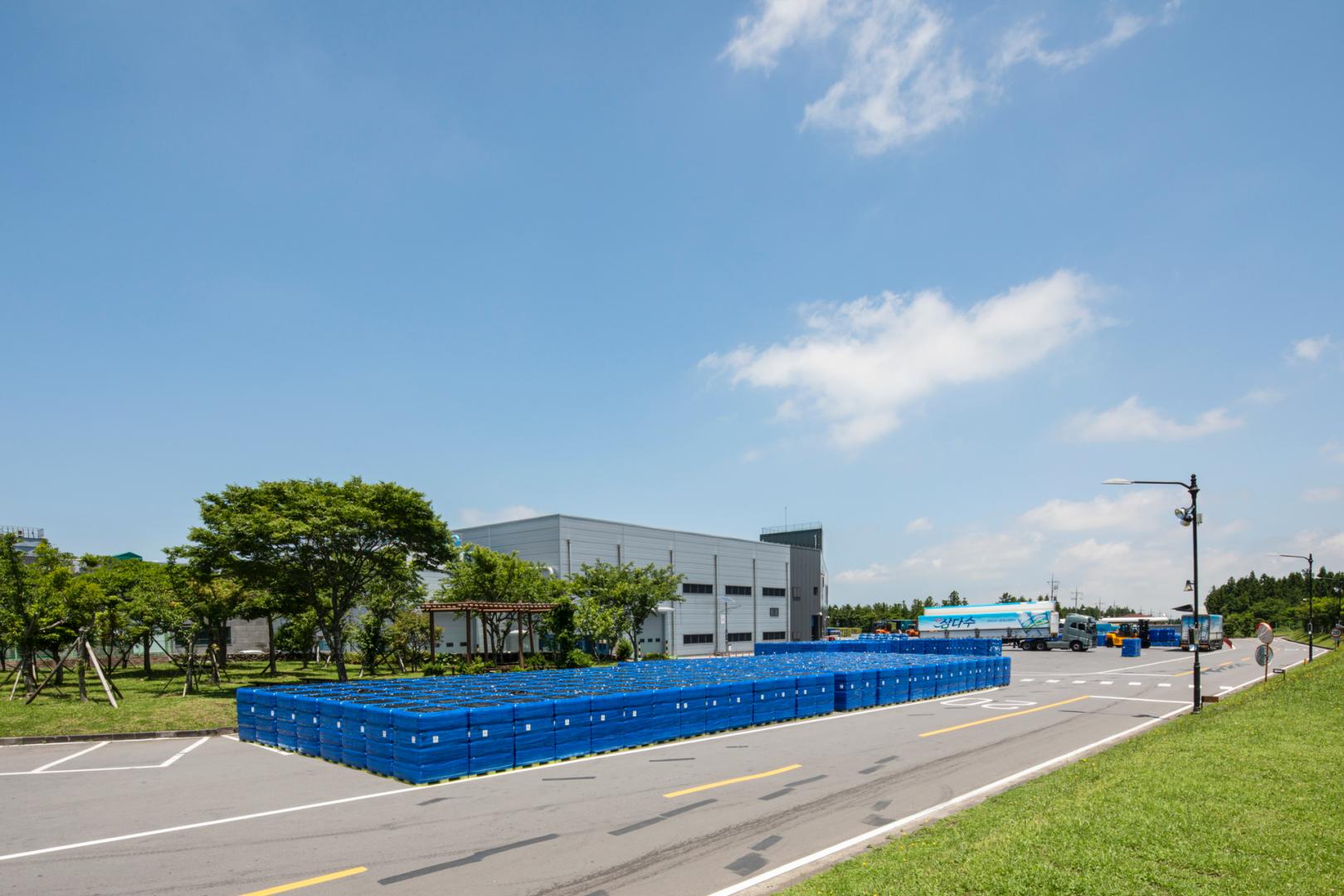
Launched in March 1998, Samdasoo has held the number-one spot for 28 straight years. In Korea, “pick up some water” means Samdasoo by default. The water is naturally filtered through Jeju Island’s volcanic bedrock aquifer, produced by the Jeju Special Self-Governing Province Development Corporation, and distributed nationwide by Kwangdong Pharmaceutical (under contract through 2029).
The key to its taste is a hardness of about 20 mg/L. That’s lower than the Korean bottled water average and roughly one-fifteenth of Evian (~300 mg/L). Calcium sits at around 3 mg/L. In other words, it’s an extremely light soft water with virtually no mineral flavor. Someone accustomed to European hard water might find it “tasteless,” but that clean, neutral blankness is exactly what Koreans love.
In the July 2026 survey by the Korea Corporate Reputation Research Institute, Samdasoo’s brand reputation index came in at 1,594,583 — more than four times the runner-up. That said, as noted above, its actual revenue has just declined for the first time. The brand trust is still there; wallets are simply wandering elsewhere.
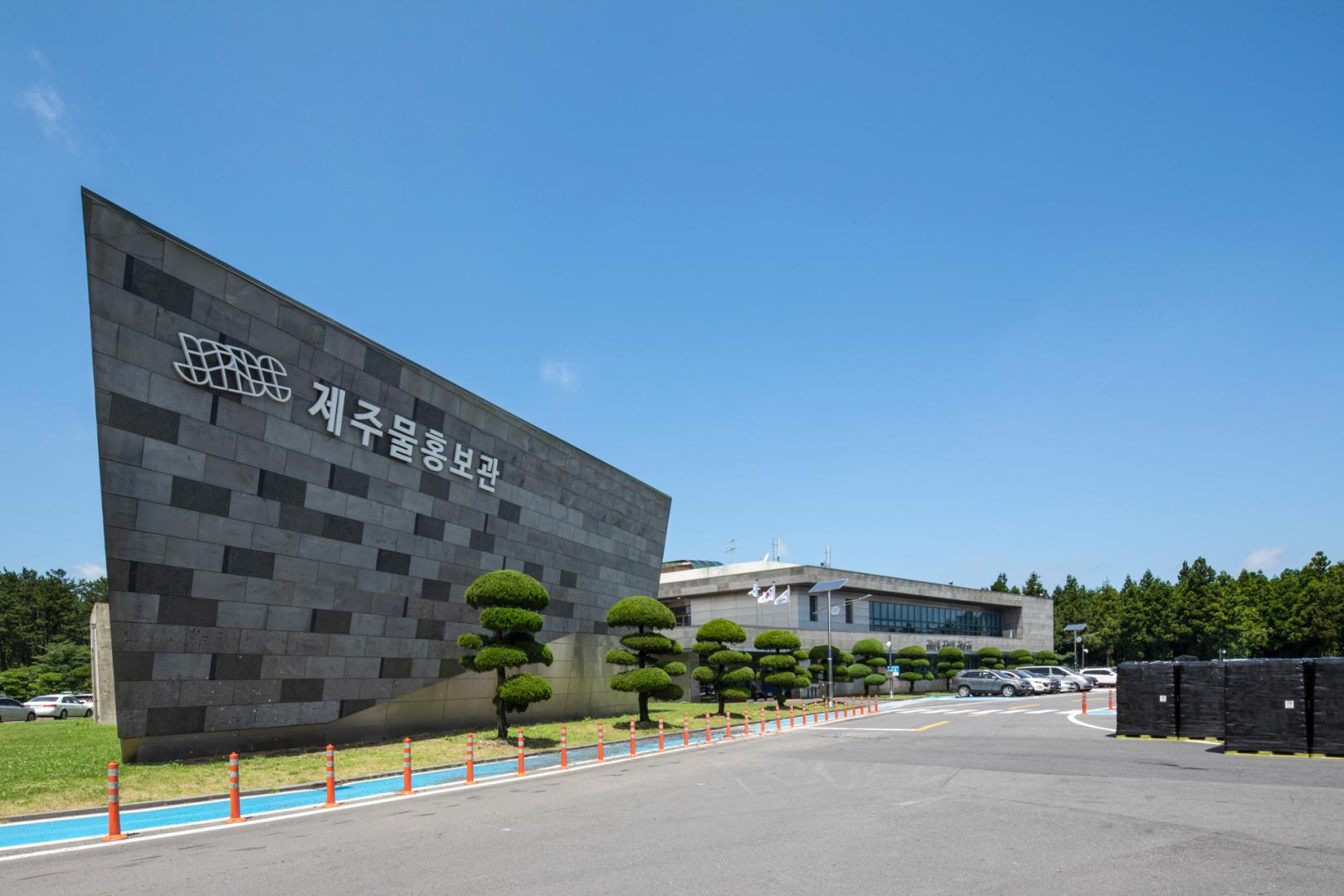
📍 Open in Naver Map (Jeju Water Promotion Hall)
2. Icis — Value and Eco-Friendliness in One
Lotte Chilsung Beverage’s flagship water, holding about 13% market share at number two. Rather than going head-to-head with Samdasoo, Icis stakes out the position of “same water, lower price.” At convenience stores, it runs about ₩850 for 500 mL — ₩100 cheaper than Samdasoo, Baeksansu, and Pyeongchangsu (₩950).
On the eco front, Icis has actually led the industry. In January 2020, it became the first Korean bottled water brand to remove labels entirely with ‘Icis 8.0 ECO.’ Then in October 2024, it introduced an ultra-lightweight PET bottle using nitrogen-charging technology, slimming the 500 mL bottle from 11.6 g to 9.4 g — an 18.9% reduction. Their ad copy sums up the strategy: “Icis is disappearing until only pure water remains.”
Icis 8.0 is a separate sub-line with calcium at 14.6–25.0 mg/L and hardness at 42–94 mg/L. That’s roughly five times Samdasoo’s levels, making it the most distinctly mineral-tasting among the top-selling products. If you prefer water with some body, this is the one. Because Icis draws from multiple water sources, the mineral content can vary noticeably from bottle to bottle.
3. Baeksansu — Baekdusan Water, 2026’s Comeback Brand
Launched by Nongshim in December 2012, Baeksansu is sourced from the Changbai Mountain (Baekdusan) National Nature Reserve in Antu County, Yanbian Korean Autonomous Prefecture, Jilin Province, China. Starting at roughly ₩24 billion in 2013, it surpassed ₩1.1 trillion in cumulative sales by the first half of 2025, averaging about 16% annual growth since launch.
What’s striking in 2026 is brand reputation. In the July 2026 survey, Baeksansu’s reputation index hit 360,874 — a 66.01% surge from April — landing it at number two. But the production numbers tell a different story: Yanbian Nongshim’s Baeksansu output dropped from 238,000 tons in 2024 to 157,000 tons in 2025, a decline of over 30% in a single year. Buzz and reality are moving in opposite directions.
With calcium at 3.0–5.8 mg/L, Baeksansu has only a whisper more mineral content than Samdasoo. In a blind tasting, most people would struggle to tell them apart.
4–8. Sparkle, Dongwon Spring Water, Pyeongchangsu, Seoksu, and Private Labels — The Rest Worth Knowing
Sparkle is a veteran brand launched in 1983, produced across four separate water sources — Daejeong-ri (Cheonan), Guryang-ri (Ulju), Daesan-ri (Gongju), and Yeongbuk-myeon (Pocheon) — and sold by Sparkle Co., Ltd. It dominates the large-format and home-delivery segment and consistently places high in brand reputation rankings (2nd to 4th place in 2025–2026).
Dongwon Spring Water and Pyeongchangsu are the workhorses of supermarket and online multi-pack sales. Pyeongchangsu (Haitai htb) has calcium at 13.2–16.1 mg/L — more mineral presence than Samdasoo. Seoksu (Hitejinro Beverage) is an old mass-market staple, the water you’ll most often find alongside delivery food or on restaurant tables.
And then there’s private-label water. E-mart’s No Brand and Peacock True Water, CU’s Heyru Mineral Water, GS25’s Yours DMZ Clear Spring Water — all fall into this bucket. They now claim roughly 15% of the market and are directly eating into the top brands’ share. Back in 2021, CU’s Heyru Mineral Water saw a 78.2% month-over-month sales jump after going label-free (compared to 20.4% growth for bottled water overall in the same period), and GS25’s Yours DMZ Clear Spring Water grew 95% every single month after launch.
Do different brands really taste different?
Yes, but nothing as dramatic as European waters. What shapes water’s taste is the total amount of dissolved minerals like calcium and magnesium — in other words, hardness. Korea’s top-selling bottled waters mostly cluster in the 10–90 mg/L soft-water range, so even when you switch brands, the “light and clean” impression largely holds.
📊 Calcium and Hardness Comparison of Major Bottled Water Brands (top-selling products, units in mg/L)
| Brand | Calcium | Hardness | Taste Impression | Best For |
|---|---|---|---|---|
| Jeju Samdasoo | 1.5–3.4 | 11–23 | Extremely light, nearly flavorless | People who don’t want to taste their water; kids and seniors |
| Baeksansu | 3.0–5.8 | 16–37 | Nearly indistinguishable from Samdasoo | A safe, inoffensive default |
| Pyeongchangsu | 13.2–16.1 | 43–52 | Subtle sweetness, smooth finish | People who find ultra-soft water too bland |
| Icis 8.0 | 14.6–25.0 | 42–94 | Most mineral character among top sellers | People who like water with some body |
| Evian (for context) | 54–87 | 218–326 | Heavy, slick mouthfeel | People accustomed to European hard water |
The key takeaway: the gap between Korean bottled waters is dwarfed by the gap between any Korean water and Evian. Samdasoo has roughly 20–30 times less calcium than Evian. When a European traveler tries Korean water and feels like it “has no taste,” that’s not in their head — it’s a real mineral-content difference. By the same token, when a Korean traveler in Europe says the water feels “greasy,” it’s the same phenomenon in reverse.
Note — Even the Same Brand Can Vary by Bottle
The mineral content of drinking spring water fluctuates depending on the water source and the extraction date, even within the same brand. Brands like Icis that draw from four or more sources show especially wide variation. That's why the numbers above are given as ranges. The exact mineral breakdown is printed on every bottle's label (or on the multi-pack wrapper for label-free products), so the most reliable numbers are the ones on the bottle you're actually holding.
How to buy bottled water for the cheapest price
Switching where you buy matters far more than switching brands. The same product can cost over 1.6 times more depending on the channel.
Price Differences by Channel — Same Samdasoo 2L (Korea Consumer Organization Council price survey)
- Convenience store: ₩1,625 — The most expensive. Rent and franchise fees are baked into the price.
- Large supermarket: ₩980 — About 40% cheaper. The same survey found Icis 2L at ₩1,550 at convenience stores vs. ₩640 at supermarkets — a 2.4x gap.
- Online multi-pack delivery — 2L × 6 or 12 packs are the cheapest format, period.
For a 500 mL bottle at a convenience store, Samdasoo, Baeksansu, and Pyeongchangsu run about ₩950, while Icis is around ₩850. Go for the store’s own private-label water and you’re down to roughly ₩700. If you’re drinking three bottles a day, choosing PB over a name brand saves ₩450–750 per day.
4 Practical Tips for Travelers
- Buy a 2L bottle at a supermarket near your accommodation first. It's dramatically cheaper than grabbing three 500 mL bottles from a convenience store throughout the day.
- Label-free bottles have no wraparound label, so you can't see the brand at a glance. Look for the cap color or the embossed marking on the bottle shoulder. The mineral info is printed on the multi-pack outer wrap.
- Watch for 1+1 or 2+1 deals at convenience stores. Bottled water is a frequent promo item. Look for the yellow stickers on the shelf price tags.
- If you want sparkling water, ask for "tansansu." Korean bottled water (mineral water) is all still by default. Trevi, Seagram's, and other sparkling waters have their own separate section in the beverage aisle.
If you’re curious about how Korean convenience stores work as a whole, check out Korea Convenience Stores Decoded — The Big 4 and What 20–30-Somethings Actually Buy. And if you’re wondering whether you even need to buy bottled water, read Is Korean Tap Water Safe to Drink?.
Why are label-free bottles everywhere now?
Ever since Icis peeled off the label in 2020 — a first in Korea — label-free has become the bottled water standard. Look inside a convenience store fridge today and more than half the bottles are clear, naked PET.
Three reasons. One, recycling gets easier — you toss the bottle as-is without peeling anything off. Two, recycled material quality goes up — clean PET with no adhesive or ink becomes high-grade recycled feedstock. Three, production costs come down — the label film, printing, and application steps disappear from the line entirely.
Consumer response was immediate. When CU’s Heyru Mineral Water went label-free in 2021, monthly sales jumped 78.2% year-on-year — about 3.8 times the overall bottled water growth rate of 20.4% during the same period. The industry now sees eco-friendliness as a new axis of brand reputation. In the July 2026 brand reputation analysis, the expansion of label-free product lines and carbon-emission reduction efforts were singled out as factors that shifted rankings.
The one downside for travelers: with no label, it’s hard to tell brands apart. You’ll need to check the embossed mark on the bottle shoulder, the cap color, or the printing on the multi-pack wrapper.
Where is the bottled water market heading?
A head-on collision between “cheap water” and “good water.” As of July 2025, Korea’s Ministry of Environment counted 59 licensed drinking spring water manufacturers and over 300 brands in circulation. With major conglomerates like Orion, Pulmuone, and LG Household & Health Care jumping in, the barrier to entry for new brands has essentially disappeared.
One industry insider’s take: “As cheap private-label products flood the market, premium bottled water sales have declined. The emergence of ultra-compact water purifiers aimed at single-person households is another headwind for bottled water. Going forward, the price competitiveness of low-cost PB products and the quality credentials of the established brands will clash head-on.”
In his July 2026 analysis, Koo Chang-hwan, director of the Korea Corporate Reputation Research Institute, noted a +6.24% rise in brand consumption and a +32.88% surge in brand communication, suggesting consumers are moving beyond simple purchase to actively engaging with water brands. At the same time, brand diffusion metrics fell 8.84% — a sign that competition is intensifying. With the market entering maturity, experts say the next battleground won’t be price itself, but eco-friendly policy and the emotional value a brand delivers.
Frequently Asked Questions (FAQ)
Q. If I can only pick one brand during my trip to Korea, which should it be?
If you’re at a convenience store, go with Icis (best value). If you’re stocking up at a supermarket, Samdasoo 2L is a safe bet. Either way, you’re unlikely to regret the taste.
Q. Is there sparkling Korean bottled water?
No — bottled mineral water (meongneun saemmul) is all still. Sparkling water is a separate category; look for Trevi, Seagram’s, and similar brands in the beverage aisle.
Q. Do hotels or guesthouses provide free water?
Hotels usually place two complimentary bottles in the room. Guesthouses and Airbnbs often don’t, so grab a 2L bottle from a supermarket on your first day.
Q. Do I have to pay for water at restaurants?
No. Korean restaurants provide free, unlimited water — usually from a water purifier — along with barley tea (boricha). Most places have a self-serve station. There’s no need to order bottled water separately.
Sources & Data
- Market share and revenue: NielsenIQ, Euromonitor, and each company's business reports (2024–2025)
- Brand reputation: Korea Corporate Reputation Research Institute, big-data analysis of 3,702,555 data points across 21 brands (June 30 – July 30, 2026)
- Mineral content and hardness: MoolDB product composition data and manufacturer label values
- Channel price comparison (Samdasoo & Icis 2L): Based on Korea Consumer Organization Council price survey via news reports. Convenience store 500 mL prices are as of 2025–2026. Actual prices vary by store and date.
- Private-label water sales growth (CU, GS25): Based on 2021 news reports
Image Credits
- Samdasoo plant production line and pallets: National Museum of Korean Contemporary History Archive / Jeju Special Self-Governing Province Development Corporation — KOGL Type 1, via Wikimedia Commons
- Jeju Water Promotion Hall: National Museum of Korean Contemporary History Archive / Jeju Special Self-Governing Province Development Corporation — KOGL Type 1, via Wikimedia Commons
Sources
- Korea’s Bottled Water Market Shaken — Traditional Powerhouse Samdasoo Posts First Revenue Decline in Over a Decade — Asia Economy (2026.03.25)
- Samdasoo Tops July 2026 Bottled Water Brand Reputation… Baeksansu and Dongwon Spring Water Chase — Businesskorea (2026.07.31)
- [Ranking Lab] Bottled Water Market Surpasses ₩3 Trillion — Top 5 Rankings and Market Share — NewsSpace
- Bottled Water Brand Reputation, December 2025 — Samdasoo, Sparkle, Dongwon Spring Water in Order — Energy News
- Which Bottled Water Has the Most Minerals? — Korea Consumer Agency, Consumer24 Product Comparison
- Bottled Water Comparison (by Hardness) — MoolDB
- Wildly Varying Water Prices… Samdasoo 2L: ₩1,625 at Convenience Stores, ₩980 at Hypermarkets — Seoul Economic Daily
- Drinking Spring Water Manufacturers and Brands (Ministry of Environment, July 2025) — Segye Ilbo (2026.03.13)
- Lotte Chilsung Icis Label-Free and Ultra-Lightweight PET — Munhwa Ilbo (2025.02.19)
- Nongshim Baeksansu Surpasses ₩1 Trillion in Cumulative Sales After 12 Years — Food Journal
- Label-Free Bottled Water Sales Surge — Hankyung (2021.03.22)
- Sparkle (Bottled Water) — Namuwiki
- Jeju Samdasoo — Namuwiki
- Baeksansu — Namuwiki