 Seoul Window
The short answer
- Korea has approved scheduled international passenger services to 44 countries on 264 routes, with up to 5,353 weekly operations for winter 2026.
- The season runs 2026-10-25 to 2027-03-27, with 84 airlines. These are authorized maximums, rather than a count of flights actually flown every week.
- Use the country rankings for actual traffic, then the city directory to find your Korean arrival airport.
Before you choose a Seoul hotel, there is a more basic question: can you get to Korea without changing planes? And if your trip is really about Busan or Jeju, why start at the other end of the country?
We rebuilt the transport ministry’s winter destination appendix into a country directory and compared it with actual flight and passenger statistics. An approved route, a flight that operated last month and a seat you can book for next Tuesday are three different things. This guide was researched on 2026-10-31 and keeps those dates and definitions visible.
How many direct flights does Korea have in winter 2026?
Up to 5,353 weekly operations on scheduled international passenger services. That is the maximum authorized by the Ministry of Land, Infrastructure and Transport (MOLIT) for 2026-10-25 to 2027-03-27. The previous winter’s figure was 4,973.
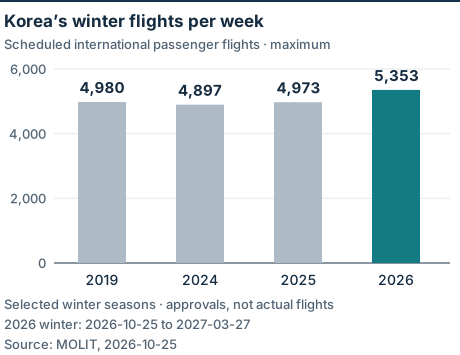
Selected winter seasons · authorized weekly maximums, not actual flights · MOLIT
| Winter season | Weekly operations |
|---|---|
| 2019 | 4,980 |
| 2024 | 4,897 |
| 2025 | 4,973 |
| 2026 | 5,353 |
Is there a direct flight from my country to Korea?
Yes from the US, UK, Australia and Singapore, with Incheon ICN the main long-haul gateway. Seoul’s other airport is Gimpo GMP. Do not treat them as interchangeable when comparing tickets.
-
From the United States: the winter appendix lists Los Angeles, New York JFK, Newark, Dallas/Fort Worth, Las Vegas, Detroit, Minneapolis, Boston, San Francisco, Salt Lake City, Seattle, Chicago, Atlanta, Washington and Honolulu for Incheon, plus Guam and Saipan. Delta’s official announcement confirms its Salt Lake City–Incheon nonstop service. The statistics below put Hawaii, Guam and Saipan in separate rows; the US ranking therefore excludes them.
-
From the UK: start with London Heathrow–Incheon. Virgin Atlantic’s current destination page says daily through 2026-12-07 and again from 2027-03-01, with changed operating days announced for 2026-12-08 to 2027-02-28; check the timetable for each direction. That is one airline’s schedule, not the total frequency between Britain and Korea.
-
From Australia: Sydney and Brisbane appear in the ministry appendix. Separately, Korean Air has announced Melbourne–Incheon seasonal service from 2026-12-18 to 2027-03-14, three times a week. Keep that announced addition separate from the appendix rather than silently adding it to the ministry’s route total.
-
From Singapore: the appendix includes Incheon, Busan and Jeju. Singapore Airlines explicitly confirms direct services to Incheon and Busan. A country having several Korean gateways does not mean every airline serves all of them.
Selected city pairs and verified airline examples · not every city or airline serving each market
| Origin market | Example city → Korean airport | Verified airline examples |
|---|---|---|
| Japan | Tokyo Haneda → Gimpo; Tokushima → Incheon | ANA; Eastar Jet |
| Mainland China | Shanghai / Qingdao → Seoul; Ningbo → Incheon (new authorization) | China Eastern; Air Premia |
| Taiwan | Taipei / Taichung → Busan | STARLUX |
| Hong Kong | Hong Kong → Incheon | Cathay Pacific |
| Vietnam | Hanoi / Ho Chi Minh City → Incheon / Busan | Vietnam Airlines |
| Indonesia | Jakarta → Incheon | Garuda Indonesia |
| United States | Salt Lake City → Incheon | Delta |
| Australia | Sydney → Incheon; Melbourne → Incheon (December seasonal plan) | Jetstar; Korean Air |
| United Kingdom | London Heathrow → Incheon | Virgin Atlantic |
| Singapore | Changi → Incheon / Busan | Singapore Airlines |
Find your actual airport pair
The country directory below collects all origins and Korean gateways for each market. It does not mean every origin connects to every gateway. Download the country–origin–Korean airport CSV for individual pairs, then check operating days and intermediate stops with the airline. A direct service can still stop en route: Aeromexico describes a Monterrey stop on its Mexico City–Seoul journey.
How many countries have direct flights to Korea?
The ministry’s winter authorization covers 44 countries; Japan leads the actual traffic rankings. These tables answer a different question from the weekly maximum: how many passenger-aircraft movements and passenger journeys were recorded in a given period?
2025 full year: country and market rankings
| Passenger rank | Country / market | Flight rank | Actual movements | Passengers |
|---|---|---|---|---|
| 1 | Japan | 1 | 148,103 | 27,317,917 |
| 2 | China | 2 | 108,536 | 16,803,863 |
| 3 | Vietnam | 3 | 53,161 | 10,349,329 |
| 4 | Taiwan | 4 | 29,080 | 5,803,155 |
| 5 | United States* | 6 | 20,992 | 5,636,716 |
| 6 | Philippines | 5 | 23,631 | 4,178,440 |
| 7 | Thailand | 7 | 19,150 | 4,130,701 |
| 8 | Hong Kong | 8 | 15,050 | 3,276,322 |
| 9 | Singapore | 9 | 10,177 | 2,284,382 |
| 10 | Malaysia | 10 | 6,761 | 1,287,970 |
September 2026, one month: country and market rankings
| Passenger rank | Country / market | Flight rank | Actual movements | Passengers |
|---|---|---|---|---|
| 1 | Japan | 1 | 14,709 | 2,647,178 |
| 2 | China | 2 | 11,308 | 1,804,158 |
| 3 | Vietnam | 3 | 3,967 | 707,725 |
| 4 | Taiwan | 4 | 3,063 | 548,138 |
| 5 | United States* | 5 | 1,949 | 496,445 |
| 6 | Hong Kong | 6 | 1,479 | 261,152 |
| 7 | Philippines | 7 | 1,302 | 220,620 |
| 8 | Thailand | 8 | 1,172 | 216,992 |
| 9 | Singapore | 9 | 795 | 171,210 |
| 10 | Canada | 12 | 401 | 111,935 |
| 11 | Indonesia | 10 | 490 | 107,648 |
Source: Airportal country statistics, retrieved 2026-10-31. Filters: international passenger aircraft; scheduled + non-scheduled; departures + arrivals; paid + transfer passengers. *The US row excludes Hawaii, Guam and Saipan, which have separate rows in the source. The 2025 table shows the top 10 by passengers; September 2026 adds Indonesia, which ranks 10th by movements. A full year and a single month are not like-for-like totals. No monthly figures have been converted into estimated weekly flights.
Nationwide totals on this basis were 497,277 movements and 94,548,031 passengers in 2025, and 45,249 movements and 8,287,517 passengers in September 2026. The full query results are available as JSON.
Incheon alone handled 73,554,772 international passengers in 2025. Its airport operator published these five leading regional categories. This is an Incheon chart, not a ranking for all Korean airports or a count of tourists by nationality.
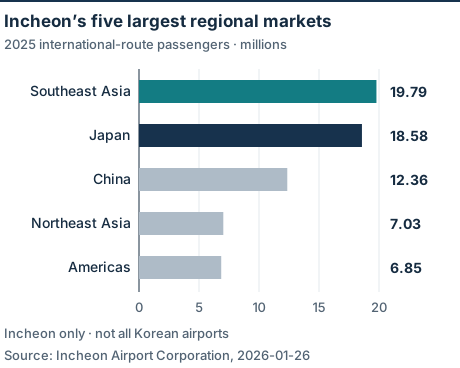
| Incheon regional category | Passengers in 2025 |
|---|---|
| Southeast Asia | 19,786,272 |
| Japan | 18,578,176 |
| China | 12,356,734 |
| Northeast Asia | 7,026,111 |
| Americas | 6,851,615 |
The airport reports Northeast Asia separately from Japan and China. We use passenger counts here because the percentages in its release use a different denominator from the international-passenger total. Another often-quoted figure, 101 airlines serving 53 countries and 183 cities, covers Incheon’s scheduled passenger and cargo network in December 2025. It has a different scope and date from the nationwide winter passenger authorization.
Why are Japan and China flights growing so fast?
MOLIT approved increases of 314 weekly operations for Japan and 232 for China compared with the previous winter. These are additions, not the total weekly schedules for either country. The ministry points to strong travel demand in both directions.
Japan’s network also stretches well beyond Tokyo and Osaka. The appendix includes Kobe, Saga, Yonago, Ishigaki and Tokushima for Incheon, and Obihiro and Ibaraki for Cheongju. Tokushima Airport’s winter timetable gives a useful reality check: Eastar Jet to Incheon runs Tuesday, Thursday and Saturday, three times weekly, for 2026-10-27 to 2027-03-27. Having a direct flight does not always mean having one every day.
For the weak-yen explanation, the source matters. Travel company HanaTour’s own first-quarter 2026 investor presentation, page 12, lists a continuing weak yen, interest in smaller Japanese cities and more airline seats among factors supporting its Japan business. That is a private operator’s analysis, rather than a government estimate of what caused this winter’s capacity increase.
Incheon Airport’s account of its 2025 results cites exchange-rate-driven demand for nearby Japan and China, plus China’s temporary visa waiver. China’s waiver for Korean ordinary-passport holders concerns Koreans entering China; the embassy notice gives an end date of 2026-12-31. It does not establish entry rights for Chinese visitors to Korea. Both directions help fill the same aircraft.
Which departure cities connect to Korea?
This directory reorganizes the MOLIT winter 2026 authorized-city appendix by country and market. Hong Kong and Macao have separate rows to make them easier to find; this is not a new explanation of how the ministry calculated its headline 44 countries. Korean gateways are a union for each market, so use the CSV for exact pairs. Separately announced additions, including Melbourne, appear in the new-service table below.
| Country / market | Origin cities and airports in the appendix | Korean gateways (union for market) |
|---|---|---|
| Japan | Kobe, Kumamoto, Kitakyushu, Nagasaki, Nagoya, Sendai, Niigata, Tokyo Narita, Tokyo Haneda, Matsuyama, Tokushima, Miyazaki, Kagoshima, Saga, Sapporo, Shimojishima, Shizuoka, Aomori, Osaka, Oita, Okayama, Okinawa, Yonago, Ishigaki, Takamatsu, Komatsu, Hakodate, Fukuoka, Hiroshima, Obihiro, Ibaraki | ICN, PUS, CJJ, TAE, CJU, GMP |
| China | Guangzhou, Guilin, Nanjing, Ningbo, Dalian, Linyi, Beijing Daxing, Beijing Capital, Sanya, Shanghai Pudong, Xiamen, Shenyang, Shenzhen, Shijiazhuang, Xi’an, Yanji, Yancheng, Yantai, Urumqi, Wuxi, Wuhan, Wenzhou, Weihai, Yichang, Jiamusi, Zhangjiajie, Zhengzhou, Jinan, Changsha, Changchun, Chengdu, Chongqing, Qingdao, Kunming, Taizhou, Tianjin, Fuzhou, Harbin, Haikou, Hangzhou, Hefei, Shanghai, Shanghai Hongqiao | ICN, PUS, CJJ, TAE, CJU, GMP |
| Taiwan | Taipei, Kaohsiung, Taichung | ICN, PUS, CJJ, TAE, CJU, GMP |
| Mongolia | Ulaanbaatar | ICN |
| Thailand | Bangkok Suvarnabhumi, Phuket, Chiang Mai | ICN, PUS, TAE |
| Indonesia | Jakarta, Bali, Batam, Manado | ICN, PUS |
| Singapore | Singapore | ICN, PUS, CJU |
| Philippines | Manila, Cebu, Clark/Angeles, Kalibo, Bohol/Tagbilaran | ICN, PUS, CJJ |
| Vietnam | Hanoi, Ho Chi Minh City, Nha Trang/Cam Ranh, Da Nang, Phu Quoc, Hai Phong | ICN, PUS, CJJ, TAE |
| Myanmar | Yangon | ICN |
| Cambodia | Phnom Penh (Techo/KTI) | ICN |
| Laos | Vientiane | ICN |
| Malaysia | Kuala Lumpur, Kota Kinabalu | ICN, PUS |
| Brunei | Bandar Seri Begawan | ICN |
| Kazakhstan | Almaty, Astana, Shymkent | ICN |
| Uzbekistan | Tashkent | ICN |
| India | Delhi | ICN |
| Sri Lanka | Colombo | ICN |
| Nepal | Kathmandu | ICN |
| Turkmenistan | Ashgabat | ICN |
| United States | Los Angeles, New York JFK, Newark, Dallas/Fort Worth, Las Vegas, Detroit, Minneapolis, Boston, San Francisco, Salt Lake City, Seattle, Chicago, Atlanta, Washington, Honolulu, Guam, Saipan | ICN, PUS, TAE |
| Canada | Vancouver, Calgary, Toronto | ICN |
| Mexico | Mexico City (Seoul-bound via Monterrey), Monterrey | ICN |
| France | Paris | ICN |
| Netherlands | Amsterdam | ICN |
| United Kingdom | London | ICN |
| Germany | Frankfurt, Munich | ICN |
| Italy | Rome, Milan | ICN |
| Poland | Warsaw, Wroclaw | ICN |
| Finland | Helsinki | ICN |
| Hungary | Budapest | ICN |
| Spain | Madrid, Barcelona | ICN |
| Austria | Vienna | ICN |
| Czechia | Prague | ICN |
| Portugal | Lisbon | ICN |
| Denmark | Copenhagen | ICN |
| United Arab Emirates | Dubai, Abu Dhabi | ICN |
| Qatar | Doha | ICN |
| Türkiye | Istanbul | ICN |
| Ethiopia | Addis Ababa | ICN |
| Australia | Sydney, Brisbane | ICN |
| New Zealand | Auckland | ICN |
| Hong Kong | Hong Kong | ICN, PUS, TAE, CJU |
| Macao | Macao | ICN, CJU |
Some appendix labels name the municipality around an airport. We use familiar search names such as Sendai for Natori, Tokushima for Matsushige, Kagoshima for Mizobe and Takamatsu for Konan. For Cambodia, we cross-checked the gateway with Korean Air and use Phnom Penh, Techo KTI.
Can I fly straight to Busan, Cheongju, Jeju or Daegu?
Yes. Check a regional arrival first if it fits your trip. The route counts below are printed in the same winter appendix. The country-group counts are our own count of that appendix, grouping Hong Kong and Macao with China as the source does. They are not a second official country-count series.
| Korean airport | Country groups counted from appendix | Routes printed in appendix | Connections to check first |
|---|---|---|---|
| Incheon ICN | 42 | 164 | Long-haul and most countries |
| Busan / Gimhae PUS | 10 | 40 | Japan, China, Taiwan, Southeast Asia, Guam |
| Cheongju CJJ | 5 | 21 | Japan, China, Taiwan, Vietnam, Philippines |
| Daegu TAE | 6 | 14 | Japan, China, Taiwan, Thailand, Vietnam, Guam |
| Jeju CJU | 4 | 25 | Japan, China, Taiwan, Singapore |
| Seoul / Gimpo GMP | 3 | 8 | Japan, China, Taiwan |
Why these counts should not be added up
The ministry says complex routings cause differences between route counts and listed destination airports. Its appendix also specifically excludes the listed Gimpo services from the scheduled-flight total, describing them as non-scheduled. That is a qualification attached to this table, not a general claim that every Gimpo international service is non-scheduled. We have not summed the rows to recreate 264.
Korea Airports Corporation says Gimhae and Cheongju have more slot capacity this winter, alongside expanded regional international services. A cheap regional arrival is useful when it matches your itinerary. For a Seoul trip, compare the onward journey too; our Incheon-to-Seoul transport comparison starts at ICN.
Which Korea routes are new or returning in 2026–27?
A first-ever city pair, a new airline on an existing route and a resumed service are different announcements. MOLIT identifies the first six China services below as new direct city pairs for this winter. Its release does not provide their individual launch dates or weekly frequencies.
| Route | Airline / announcing body | Status and confirmed period or frequency |
|---|---|---|
| Incheon–Ningbo | Air Premia · MOLIT | First city-pair authorization, winter 2026 |
| Incheon–Linyi | Trinity · MOLIT | First city-pair authorization, winter 2026 |
| Busan–Xiamen | Eastar Jet · MOLIT | First city-pair authorization, winter 2026 |
| Cheongju–Xiamen | Eastar Jet · MOLIT | First city-pair authorization, winter 2026 |
| Busan–Guangzhou | Air Busan · MOLIT | First city-pair authorization, winter 2026 |
| Jeju–Shijiazhuang | Spring Airlines · MOLIT | First city-pair authorization, winter 2026 |
| Incheon–Melbourne | Korean Air | Airline seasonal service; 2026-12-18 to 2027-03-14, 3 weekly |
| Incheon–Oita | Korean Air | Airline resumption; 2026-10-25 to 2027-03-26, 4 weekly |
| Incheon–Hiroshima | Korean Air | New for this airline; daily planned from 2026-12-23 |
| Kuala Lumpur–Busan | Malaysia Airlines | Airline resumption; 4 weekly planned from 2026-12-02 |
| Busan–Haneda | Korea Airports Corporation announcement | First non-scheduled service planned for December 2026; announced as 1 daily |
These additions do not all run daily for the full winter. Melbourne is seasonal, while Busan–Haneda is a non-scheduled plan. Virgin Atlantic’s London service runs daily through 2026-12-07 and again from 2027-03-01, with changed operating days announced for 2026-12-08 to 2027-02-28; check the timetable for each direction.
What if my country has no direct flight to Korea?
Connect through another international hub, then fly into Incheon. The winter appendix lists no South American cities. Doha, Dubai, Istanbul and European or North American hubs are possible search points, depending on your origin. Qatar Airways explicitly describes its Seoul–São Paulo itinerary as connecting in Doha. Check both directions and your travel dates before settling on a route.
Africa is not entirely missing: Addis Ababa, Ethiopia, appears in the ministry’s Incheon list. For other African origins, compare connections through Addis Ababa, Doha, Dubai or Istanbul. The UAE and Qatar also appear in the appendix, but not every Middle Eastern country has a listed direct Korean connection.
Three details worth checking before you book
- Open the itinerary details: does the aircraft stop on the way, and do you change planes? “Direct” can include an intermediate landing.
- Check whether the flights share one protected booking and whether bags are checked through.
- For an onward Korean flight, check the airport code. An arrival at ICN followed by a departure from GMP means changing airports.
For time between flights, see our Incheon layover plans and airport transit hotels. Leaving the airport and transferring baggage are separate questions to confirm for your ticket.
Sources and definitions
- MOLIT winter 2026 schedule authorization (2026-10-25) · Official government PDF; destination appendix on page 3.
- Airportal country statistics · 2025-01 to 2025-12 and 2026-09; passenger aircraft / scheduled + non-scheduled / departures + arrivals / paid + transfer.
- Incheon 2025 traffic results (2026-01-26) · Incheon network scope: 101 airlines, 53 countries, 183 cities (2026-01-28).
- Korea Airports Corporation winter regional-airport plans (2026-10-28).
- Korean Air Melbourne seasonal service · Oita resumption · Hiroshima launch.
- Malaysia Airlines Busan resumption (2026-09-04) · Virgin Atlantic London–Incheon seasonal timetable.
- ANA Haneda–Gimpo winter schedule · Tokushima Airport winter timetable · Takamatsu Airport Jin Air timetable.
- China Eastern winter plan · STARLUX Busan launch · Cathay Hong Kong–Seoul.
- Vietnam Airlines nonstop-route announcement · Hanoi–Seoul current sales · Garuda Jakarta airline notice · Garuda Bali cancellation notice.
- Delta Salt Lake City launch · Sydney Airport Jetstar nonstop service · Singapore Airlines direct Incheon and Busan services.
- Korean Embassy notice on direction and expiry of China visa waiver · HanaTour Q1 2026 investor presentation, page 12 (private source).
- Korean Air Phnom Penh KTI–Incheon · Aeromexico Mexico City–Seoul intermediate stop · Qatar Airways Seoul–São Paulo via Doha.
- Current route cross-checks: Vietnam Airlines · STARLUX Taichung–Busan · Delta Salt Lake City (2026-10-01).
Researched 2026-10-31. Charts drawn from official figures. Each table states whether it describes actual traffic, authorization or an airline plan, with its own period.