Here is the short version, and it holds as of July 2026: unless you are spending Japanese yen, your money goes further in Seoul today than it did five years ago. We tracked monthly exchange rates for nine currencies against the Korean won — from January 2021 to now — and lined them up. The won has slipped a long way, and a weaker won means your dollars, euros, yuan or baht convert into more won at the counter.
The short answer (as of July 2026)
- The won is weak, so most foreign currencies buy 16–38% more won than in early 2021. In plain terms, Seoul is cheaper for you than it used to be.
- Biggest gains: Singapore dollar +38%, US dollar +34%, Hong Kong dollar +33%, yuan +28%, euro +26%.
- Middle of the pack: Thai baht +20%, Vietnamese dong +18%, Taiwan dollar +16%.
- The one exception: the Japanese yen, −14%. The yen fell further than the won, so Japanese visitors had it better in 2021.
Is now a good time to visit Seoul for the exchange rate?
For most travelers, yes — and the reason is simple. Over the past five years the Korean won has lost value, and a weaker won means the money you bring converts into more won than before. Same Seoul prices, smaller bill in your own currency.
The clearest way to feel it: how much does 100,000 won — a light dinner plus a taxi, or part of a night in a mid-range hotel — cost you now versus in early 2021?
| Currency | January 2021 | July 2026 | Change |
|---|---|---|---|
| US Dollar | $90.9 | $67.8 | 25% cheaper |
| Euro | €74.7 | €59.4 | 21% cheaper |
| Chinese Yuan | ¥589.6 | ¥458.8 | 22% cheaper |
| Hong Kong Dollar | HK$704.9 | HK$531.4 | 25% cheaper |
| Taiwan Dollar | NT$2,546 | NT$2,189 | 14% cheaper |
| Singapore Dollar | S$120.6 | S$87.5 | 27% cheaper |
| Thai Baht | ฿2,729 | ฿2,280 | 16% cheaper |
| Vietnamese Dong | ₫2,100,000 | ₫1,782,000 | 15% cheaper |
| Japanese Yen | ¥9,442 | ¥11,013 | 17% more expensive |
Read it this way: a smaller number in the July 2026 column means the same 100,000 won costs you less of your own money — good news for you. Only the yen goes the other way.
How much more (or less) does your money buy than 5 years ago?
Because a Vietnamese dong is worth about 5 won and a euro about 1,700, you can’t compare them on the same axis. So the chart below indexes each currency to 100 at January 2021 and tracks it to July 2026. A line above 100 means that currency now buys more won than it did — Seoul got cheaper for those travelers. A line below 100 means the opposite.
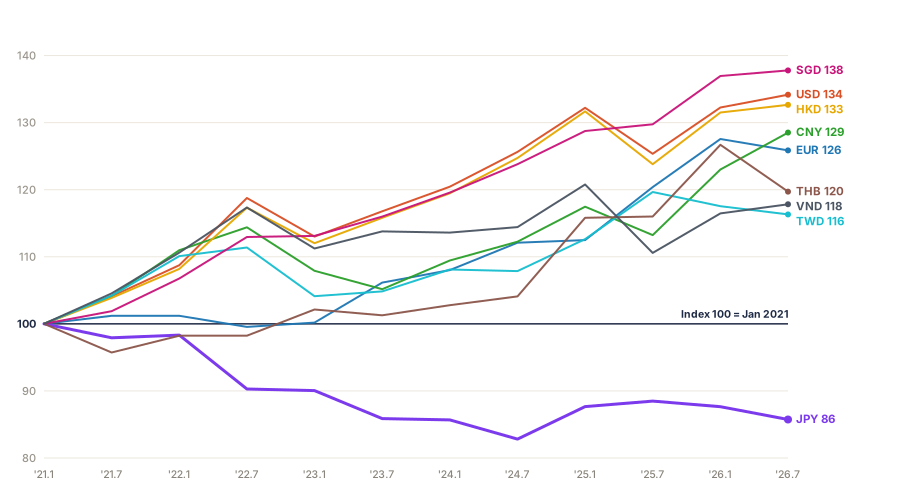 Nine currencies vs the Korean won, indexed to Jan 2021 = 100. Above the line = your money buys more won now. Data as of 20 July 2026.
The exact figures, from monthly averages to the current rate:
| Currency (per unit) | Jan 2021 | Jul 2026 (now) | 5-year change | 1-year change |
|---|---|---|---|---|
| US Dollar (1 USD) | 1,099.8 | 1,475.5 | +34.2% | +7.0% |
| Euro (1 EUR) | 1,338.0 | 1,684.0 | +25.9% | +4.5% |
| Japanese Yen (100 JPY) | 1,059.1 | 908.1 | −14.3% | −3.1% |
| Chinese Yuan (1 CNY) | 169.6 | 218.0 | +28.5% | +13.5% |
| Hong Kong Dollar (1 HKD) | 141.9 | 188.2 | +32.7% | +7.1% |
| Taiwan Dollar (1 TWD) | 39.28 | 45.69 | +16.3% | −2.8% |
| Singapore Dollar (1 SGD) | 829.4 | 1,142.7 | +37.8% | +6.2% |
| Thai Baht (1 THB) | 36.64 | 43.86 | +19.7% | +3.2% |
| Vietnamese Dong (100 VND) | 4.76 | 5.61 | +17.8% | +6.5% |
“5-year change” is versus January 2021; “1-year change” is versus July 2025. A plus sign means the currency buys more won now — better for the traveler.
Currency by currency: how the nine have moved
Here is the actual won rate for each currency over the five years. In each panel, the left number is January 2021 and the right number is July 2026.
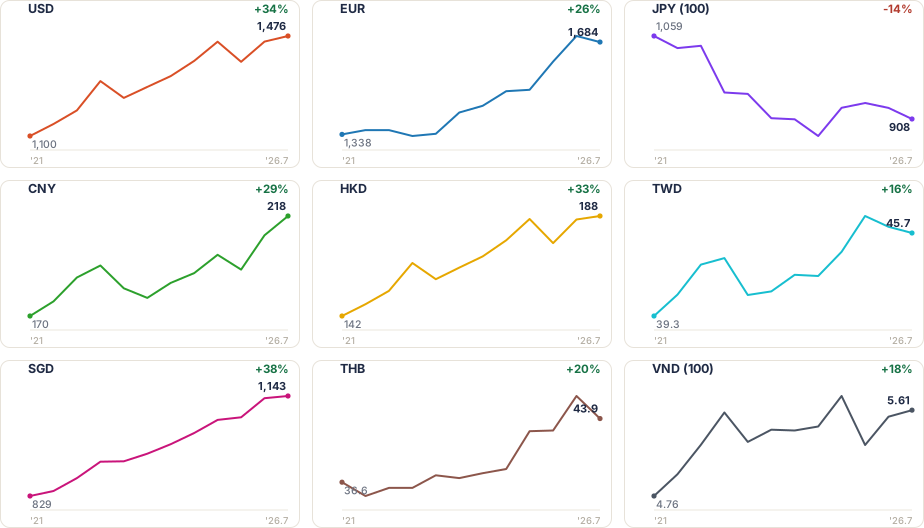 Each currency’s real KRW rate, 2021 → July 2026 (yen and dong shown per 100 units). As of 20 July 2026.
The big winners — Western, Greater China, and part of Southeast Asia. The Singapore dollar (+38%), US dollar (+34%) and Hong Kong dollar (+33%) gained most. The Hong Kong dollar is pegged to the US dollar, so it shadows the greenback almost exactly. The yuan (+28%) and euro (+26%) follow. Travelers from these currencies will feel the difference — and the euro sits near its strongest-ever level against the won, helped by a firm euro in 2025–2026.
The middle — Taiwan, Thailand, Vietnam. The Thai baht (+20%), Vietnamese dong (+18%) and Taiwan dollar (+16%) are stronger than in 2021, but by less, because these currencies also softened against the US dollar over the same stretch. The Taiwan dollar is the one non-yen currency that is slightly worse than a year ago (−2.8%): it spiked to about 47 won in mid-2025, then eased back below 46.
The exception — the Japanese yen. The yen is the only line that dropped below 100. 100 yen bought about 1,059 won in January 2021 and about 908 now — 14% fewer won. The won weakened, but the yen weakened more. So for Japanese travelers the honest answer is that Seoul was a better bargain five years ago. That said, the yen is soft against nearly everything, so a short hop to Seoul is still an easier trip than most.
Why has the Korean won weakened?
Three things stacked up. First, the strong-dollar era since 2022 pushed most Asian currencies lower against the US dollar, and the won was no exception. Second, factors closer to home — interest-rate gaps with the US, the export cycle, and Korea’s broader economic and political backdrop — added pressure. Third, the yen’s own long stretch of ultra-loose policy sent it down even faster than the won, which is why the yen ends up as the lone exception here. The won touched roughly 1,560 per US dollar in June 2026 — its weakest since around March 2009 — before recovering into the 1,470s in July.
Exchange rates move every day. The “now” in this guide is 20 July 2026; the rate on your travel dates will differ.
Practical money tips for Seoul (2026)
A favorable rate does not mean “change everything today.” A few things that actually help on the ground:
Cards win most of the time. Seoul takes card and mobile payment almost everywhere, down to small amounts. When a terminal asks whether to charge you in your home currency, say no and pick Korean won (KRW) — dynamic currency conversion quietly adds a markup.
Carry a little cash. Traditional markets and some street stalls still want small notes. Airport exchange counters give poor rates, so pair a small cash exchange in the city with card withdrawals rather than changing a big sum at arrivals.
Get a T-money card. One rechargeable card covers subway, bus, most taxis and even convenience-store buys. It has nothing to do with exchange rates and everything to do with never fumbling for coins.
This guide is travel information, not financial advice. Rates and fees change constantly — if you are exchanging a large amount or timing a transfer, check your bank’s live quoted rate first.
Data & method (as of July 2026)
Past readings (January and July of each year, 2021–2026) use that month’s average exchange rate. The “now” figure uses the spot rate on 20 July 2026, because the won moved sharply within the month and a recent rate reflects what you would actually get. For currencies with thin direct won quotes — the Hong Kong dollar, Taiwan dollar and Vietnamese dong — we cross-checked against US-dollar cross rates, and all nine “now” values are pinned to the same date (20 July) so they compare cleanly. Yen and dong are shown per 100 units so the numbers sit on a readable scale.
Sources
- Monthly average rates — exchangerates.org.uk (USD, EUR, JPY, CNY, HKD, TWD, SGD, THB vs KRW, 2021–2026)
- Cross-check of monthly averages — x-rates.com
- Daily spot rates for July 2026 — valutafx.com (all nine currencies, 20 July 2026)
- Recent won trend and multi-year low — Trading Economics: South Korean Won