The Short Answer
- Do not ask "can you go to Hongdae?" or "how much?" through the window. That question is the trap. It hands the driver a chance to size you up and drive away, and a refusal at the window is the hardest kind to prove.
- If the red 빈차 (vacant) light is on, open the door and get in. Say your destination once you are seated. If the driver then orders you out, that is still ride refusal under Korean law, and now you have the plate number, the exact time, and a recording.
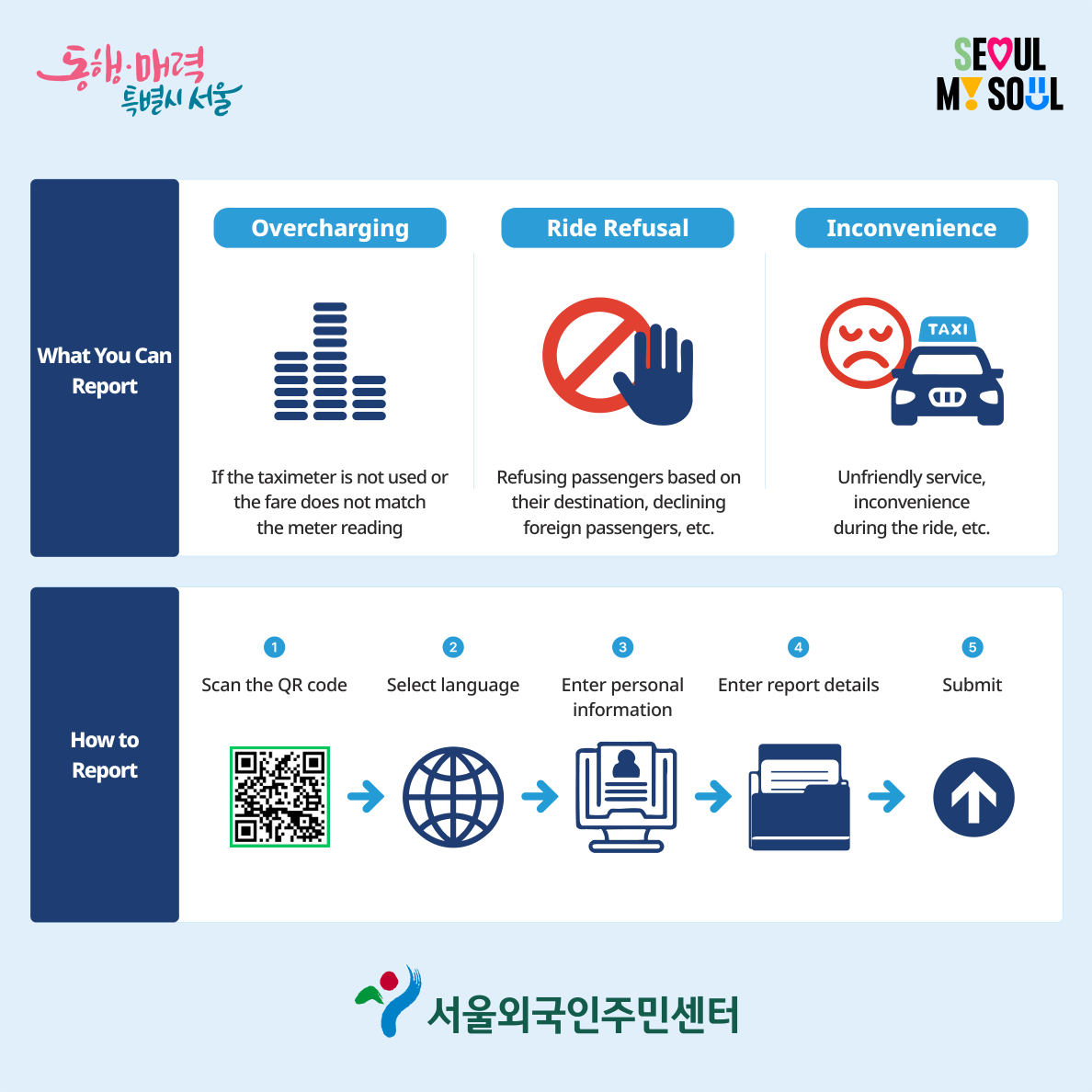
- Report it with the QR code. Five steps, your own language, no Korean needed. A confirmed ride refusal costs the driver 200,000 won and a warning on a first offence, and his licence on a third.
Seoul taxis are metered, card-enabled and, by global standards, unusually honest. But foreign passengers still get turned away at the kerb late at night in Hongdae, Itaewon and Myeongdong, and still get charged more than the meter says. In 2025 alone, 487 foreign passengers filed taxi complaints through Seoul’s new QR system in just over six months, and overcharging was the single most common category.
The good news is that the city takes these reports seriously, that the process is now genuinely five taps long, and that one small change in how you hail a cab makes almost all of it avoidable.
What should you do the moment a Seoul taxi refuses you?
Get in first. Argue later.
The instinct almost every visitor has is to lean toward the passenger window, ask “Gangnam? Can you go?”, and wait for a nod. Do not do this. The moment you ask through the glass, you have given the driver a free option: he can look at your luggage, guess your destination is short or awkward, and simply pull away. You are left standing on the pavement with nothing — no plate number you had time to read, no recording, no proof that anything happened at all.
The one rule that changes everything
If the taxi is stopped in front of you and the 빈차 (bincha, "vacant") light is glowing red on the dashboard, open the rear door and sit down. Then say your destination. Do not negotiate a price. Do not ask permission. A licensed Seoul taxi showing a vacant light is legally obliged to take you.
This is not a loophole. It is how the law is actually written. Seoul’s own enforcement guidance lists “stopping in front of a passenger, asking the destination, then departing without picking them up” as case ① of ride refusal — and “making a passenger who has already boarded get out because the direction does not suit” as case ②. Both are illegal. But only in the second case do you walk away with the driver’s plate number, the timestamp on your phone, and a recording of him telling you to leave.
What actually counts as ride refusal in Seoul?
The Seoul Metropolitan Government publishes an explicit list. If any of these happened to you, you have a valid report.
🚕 Conduct classified as ride refusal (승차거부) by Seoul Metropolitan Government
| # | What the driver did | Counts as refusal? |
|---|---|---|
| 1 | Stopped in front of you, asked your destination, then drove off without you | ✅ Yes |
| 2 | Made you get out after you had boarded, because your direction “did not suit” | ✅ Yes |
| 3 | Told you to cross the road and catch a taxi going the other way instead of taking you | ✅ Yes |
| 4 | Deliberately switched off the vacant light or ran the “reserved” light while crawling along, shouting at pedestrians to cherry-pick destinations | ✅ Yes |
| 5 | Refused because your trip was too short, or told you to take the next car instead | ✅ Yes |
| 6 | Kept the doors locked and waved you away, or would not open the door at all | ✅ Yes |
| 7 | Demanded money on top of the meter, then threw you out when you refused | ✅ Yes |
| 8 | Accepted your app booking, sent the confirmation text, then never arrived or phoned to cancel | ✅ Yes |
Note case 4 in particular. A taxi cruising slowly with its vacant light off while the driver leans out asking where you are going is not being helpful — under Seoul’s rules that is a documented refusal tactic, and reportable.
When is a driver allowed to say no?
Reporting a lawful refusal wastes your evening and the city’s time, so it is worth knowing the exceptions. Seoul lists ten; these are the five you will actually encounter.
| Situation | Why it is legal |
|---|---|
| Your destination is outside the taxi’s licensed business area | A Seoul-licensed taxi may decline a trip that leaves its operating zone |
| You are too drunk to state a destination | Unless a sober companion is with you, in which case refusal is not allowed |
| The driver is within one hour of a shift change | Only if the shift-change sign is displayed and visible from outside |
| You are carrying a loose pet | Animals in a carrier or bag are fine; loose animals may be refused |
| You flagged the car down from lane 1 or 2 of a wide road | Drivers are not required to cut across fast lanes to reach you |
There is one more worth remembering: if your destination genuinely lies in the opposite direction and the driver tells you so in advance, any extra fare from the detour is not overcharging. Being told the truth up front is not a refusal.
How do you collect evidence in 30 seconds?
You do not need a case file. Seoul’s report form needs surprisingly little — but what it needs, it needs precisely.
Do this before you argue, not after
- Start a voice recording. In South Korea, recording a conversation you are personally part of is legal without the other person's consent — the law only bans recording other people's conversations. Press record, then talk.
- Photograph the licence plate. This is the single most important field on the form. Capture the whole plate including the region characters, and note that Seoul plates begin with 서울.
- Photograph the driver ID card mounted on the dashboard, if you are already inside the car.
- Pay by card and keep the receipt. Since 2025 Seoul receipts print in English and show whether a late-night or out-of-city surcharge was applied — which makes an overcharge visible at a glance.
- Note the time and the exact spot. A screenshot of your map app with the pin dropped does this in one tap.
Do not escalate. If a driver becomes aggressive, get out, stand somewhere well-lit, and report from there. Nothing on the form is worth a confrontation on a dark street.
How do you report a Seoul taxi by QR code?
Seoul introduced the QR complaint system in June 2025 specifically because foreign passengers were leaving the country before anyone could interview them. All 71,000 Seoul taxis now carry a QR sticker inside the cabin. If you have already left the taxi, or you never got in, use the code below instead.

📱 Official Seoul taxi complaint form — English, Chinese and Japanese supported
📝 Open the report formThe form takes five steps: scan the code → choose your language → enter your contact details → describe what happened → submit. No Korean is required at any point.
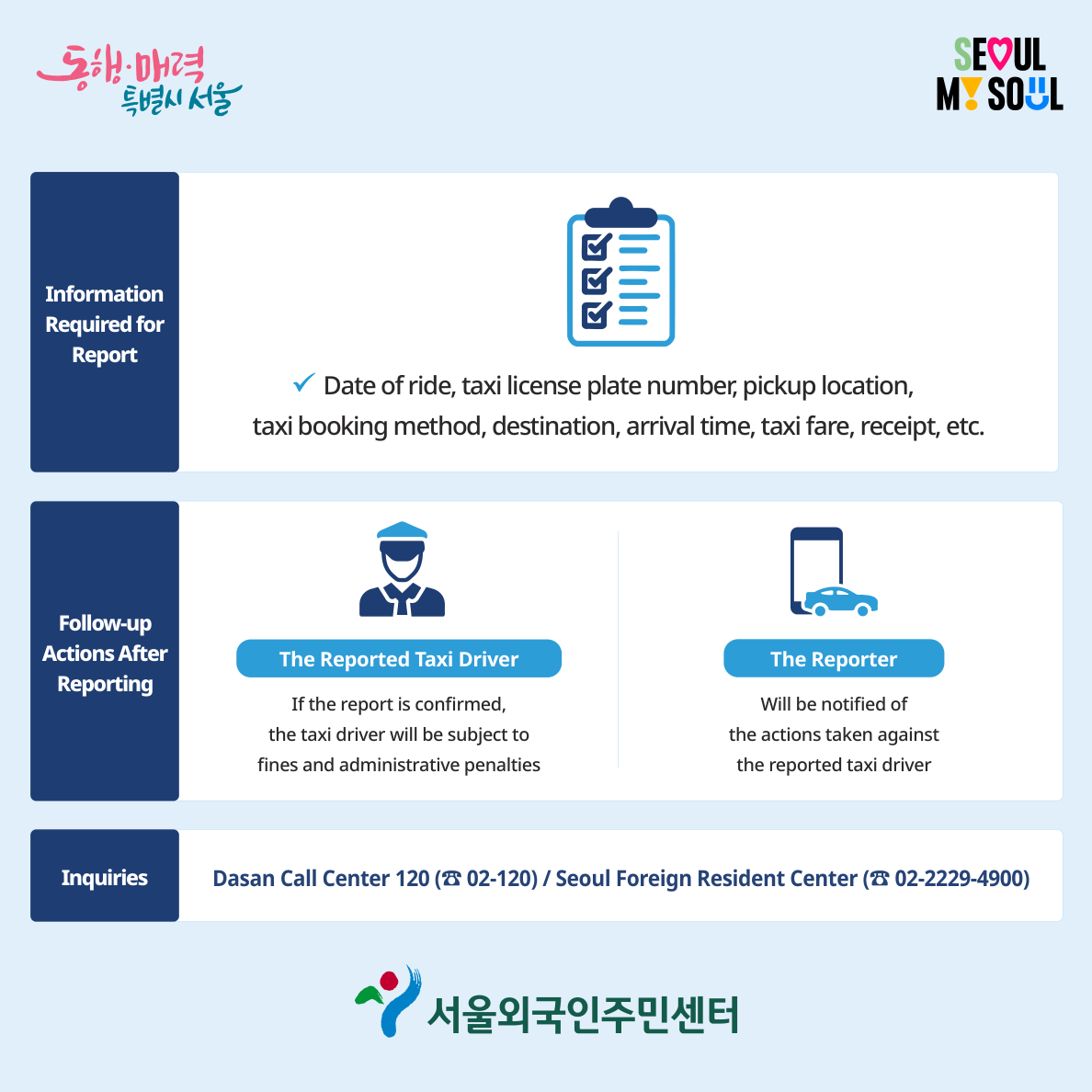
📋 What the form asks for
| Field | Required? | Notes |
|---|---|---|
| Taxi licence plate number | Essential | Seoul calls this “the most important item.” Include the region characters |
| Date and time of the ride | Essential | Approximate to the minute is fine |
| Pickup location | Essential | A landmark or intersection is enough |
| Your name and contact details | Essential | Needed so the city can send you the outcome |
| Destination and arrival time | Recommended | |
| How you hailed the taxi | Recommended | Street hail, app booking, or taxi stand |
| Fare paid and receipt | Recommended | Decisive in an overcharging case |
| Photos or audio | Optional | Not formally required, but strengthens the file |
What happens to the driver after you report?
More than most travellers expect. These are administrative penalties under the Taxi Transport Business Development Act, and they stack across a two-year lookback window.
The operating company is penalised separately: a first ride-refusal by one of its drivers can mean a 60-day partial suspension of operations, a second a fleet reduction order, a third the loss of the business licence entirely.
Timing-wise, if the driver admits the violation the case closes within 10 days. If he contests it, the district office holds a hearing and the review committee decides, which takes 30 to 60 days. Either way, you are notified of the outcome by text message — this is not a complaint that vanishes into a void.
What are the other ways to complain?
The QR form is the fastest route, but it is not the only one.
| Channel | Best for | Contact |
|---|---|---|
| QR complaint form | Anything taxi-related, in your own language | Sticker in the cab, or the code above |
| Dasan Call Center 120 | Seoul-specific issues, live help | Dial 120 (02-120 from abroad) |
| Seoul Foreign Resident Center | Follow-up help in your language | 02-2229-4900 |
| 1330 Korea Travel Helpline | 24/7 multilingual, any tourism problem nationwide | Dial 1330 |
| Eungdapso (Seoul e-petition) | Written complaint with attachments | eungdapso.seoul.go.kr |
| Kakao T in-app report | Rides booked through the app | Ride history → report |
Prevention beats reporting
Book through Kakao T whenever you can. The app logs your route, your fare and the driver's identity before the ride even starts, which removes the entire category of problems this article is about. Street hailing is still fine in daylight and in central Seoul — the friction is concentrated in the 11 PM to 2 AM window, when a 40% late-night surcharge is running and drivers are choosing between fares.
For the full fare table, surcharge bands and taxi types, see our Seoul taxi fares and overcharging guide. If you are out after the last train, our late-night transport guide covers Owl Buses and last-train times.
📊 Sources
- Seoul Metropolitan Government Traffic — Ride Refusal (Taxi): definition, penalties, qualifying conduct and exceptions (updated 2026-03-10)
- Seoul Metropolitan Government Traffic — Unfair Fare Collection: penalties and surcharge rules
- Seoul Metropolitan Government Traffic — Complaint Procedure and Penalty Details
- Seoul Metropolitan Government — Simple QR Reporting of Taxi Problems for Foreign Visitors (2025-07-02)
- Seoul Foreign Resident Center — official multilingual leaflet, "Report Seoul Taxi Overcharging and Ride Refusal by QR Code" (English, Chinese, Japanese editions)
- Protection of Communications Secrets Act, Articles 3 and 14 — recording by a party to the conversation