 Seoul Window
The short answer
- Korea has two kinds of "zero" beer. 무알코올 (mu-alkool) means no alcohol. 비알코올 (bi-alkool) means less than 1%. Both are legally soft drinks, since liquor starts at 1% under the Liquor Tax Act.
- Read the back label, not just the big "0.0" or "ZERO" on the front. Alcohol-free drinks should say 무알코올(성인용); the under-1% ones should say 에탄올 1% 미만 함유.
- Restaurants have been able to get these drinks through their regular liquor wholesaler since May 28, 2024, so BBQ places and pubs stock them more and more. Ask before you assume.
- Choosing not to drink is becoming normal: in Opensurvey's 2026 survey of Koreans aged 20 to 39, 77.4% had tried non-alcoholic drinks.
Pull open the fridge door at any Seoul convenience store and you’ll see it: a whole row of cans that look like beer, say “ZERO” in huge type, and are not beer in the legal sense. Some have no alcohol at all. Some have a little. The front of the can doesn’t always make the difference obvious, which matters a lot if you’re Muslim, pregnant, driving, or just done drinking for the night.
This guide covers how to tell them apart, what to order where, the Korean you need, and why so many young Koreans are reaching for these cans in the first place.
What's the difference between 0.00% and 0.0% beer in Korea?
Korea splits “zero” beer into two legal groups, and the decimal on the can is the industry’s shorthand for which is which. Under the Liquor Tax Act, a drink only counts as liquor (주류) at 1% alcohol or more. Anything below that is a beverage, and it falls into one of two groups that the Ministry of Food and Drug Safety (MFDS) describes this way:
The two kinds of "zero" beer in Korea
| Korean term | Romanized | What it means | What the label should say |
|---|---|---|---|
| 무알코올 | mu-alkool | No alcohol (alcohol-free) | 무알코올(성인용) |
| 비알코올 / 논알코올 | bi-alkool / non-alkool | Less than 1% ethanol (non-alcoholic) | 비알코올(에탄올 1% 미만 함유, 성인용) |
Note the confusing English: in Korea, “non-alcoholic” (비알코올) is the group that can contain alcohol, and “alcohol-free” (무알코올) is the group that doesn’t. Both carry 성인용 (seong-inyong, “for adults”), and MFDS asks that children and teens not drink either.
On the front of the can, brewers use a shortcut. According to Segye Ilbo and The Fact, the industry generally prints 0.00 on alcohol-free products and 0.0 on non-alcoholic ones. Segye Ilbo also reported the cut-offs MFDS uses when it tests products: ethanol below 0.001% for 무알코올, and from 0.001% up to under 1.0% for 비알코올. Most under-1% beers contain only a trace, but “trace” is not “none”.
Practical tip
Turn the can around. Look for the word 무알코올 or the phrase 에탄올 1% 미만 함유 ("contains under 1% ethanol") near the product information. MFDS revised the labeling rules in 2021 so that the alcohol notice on these drinks must stand out from the background color.
Does the label matter for halal, pregnancy or driving?
Yes. This is exactly where the 0.00 vs 0.0 difference stops being trivia.
- If you avoid alcohol for religious reasons: only 무알코올 means no alcohol. A 비알코올 beer may contain up to just under 1%. Keep in mind that the label is about alcohol content, not halal status. Whether a beer-style drink is acceptable at all is for your own religious guidance to decide, and halal certification in Korea is a separate process run by the Korea Muslim Federation. Our Seoul halal restaurant guide marks which places serve alcohol, and the Seoul Central Mosque guide covers the Itaewon area around it.
- If you're pregnant: both kinds are sold as adult drinks, and 비알코올 ones contain some alcohol. Ask your doctor before you drink either.
- If you're driving: Korea's legal limit is a blood alcohol concentration of 0.03% (Road Traffic Act, Article 44). If you have the wheel, pick 무알코올. The rest of the drinking rules, from Hangang Park to ID checks, are in our Korea drinking rules guide.
Which non-alcoholic beers can you buy in Korea?
Korea’s three big brewers all make one, and convenience stores carry imports too. These are the ones you’re most likely to see, with how each maker or recent press describes the alcohol content.
Non-alcoholic and alcohol-free beers in Korea (as of October 2026)
| Product | Maker | Front label | Group |
|---|---|---|---|
| Hite Zero 0.00 (하이트제로 0.00) | HiteJinro Beverage | 0.00 | 무알코올. On sale since 2012 and the best-selling single brand, with 36.8% of the market (Hankyung) |
| Terra Zero (테라 제로) | HiteJinro | 0.00 | 무알코올 per the maker, which calls it 100% alcohol-free. Cans from March 2026, bottles for restaurants and bars from June 30, 2026 |
| Cass Zero (카스 제로) | OB Beer | 0.00% | Relaunched in May 2026 with a 0.00% label (first released in October 2020) |
| Cass All Zero (카스 올제로) | OB Beer | 0.00 | Launched in 2025 |
| Cass Lemon Squeeze Zero (카스 레몬 스퀴즈 제로) | OB Beer | 0.00% | Lemon-flavored. In convenience stores, supermarkets and restaurants from August 1, 2026 |
| Hite Non-Alcoholic 0.7% (하이트 논알콜릭) | HiteJinro Beverage | 0.7% | 비알코올. Contains 0.7% alcohol, printed on the front |
| Kloud Non-Alcoholic (클라우드 논알콜릭) | Lotte Chilsung | Non-alcoholic | 비알코올, under 1% (launched January 2025) |
| Heineken 0.0 | Heineken | 0.0 | 비알코올. Reported at under 0.03% |
| Guinness 0.0 | Diageo Korea | 0.0 | 비알코올. Reported at under 0.05%; launched in Korea in April 2024 |
The group column follows the front label and the maker’s description. The back label is what counts, and recipes and packaging change, so check it every time.
Prices vary by store and by promotion (convenience stores run constant 2+1 and 4-can deals), so go by the shelf tag. Our soju and beer price guide explains why the same can costs more at a restaurant than at a mart.
Beyond beer
The shelf is widening. emart24 told Jaekyung Ilbo that its non-alcoholic wine sales from July 1 to 8, 2026 were up 493% on a year earlier, and non-alcoholic beer up 33%. E-Mart released a non-alcoholic highball, Zen Highball, in December 2024, Herald Corporation reported. For a tour of what else is in the fridge, see our guide to Korean convenience store brands.
Can you order non-alcoholic beer at Korean BBQ restaurants and bars?
Increasingly, yes, and that’s a recent change. Until 2024, general liquor wholesalers, the companies that deliver beer and soju to restaurants, could only distribute products with at least 1% alcohol. An amendment to the Enforcement Decree of the Liquor License Act took effect on May 28, 2024. It allows those wholesalers to also handle non-alcoholic and alcohol-free drinks labeled for adults, so a samgyeopsal restaurant can now order Hite Zero with its Chamisul.
Brewers followed. HiteJinro launched bottled Terra Zero on June 30, 2026, aimed at restaurants and bars, and OB Beer put Cass Lemon Squeeze Zero into restaurants from August 1, 2026. Coverage still depends on the place. A big BBQ chain near a station is more likely to have it than a tiny pojangmacha tent.
Practical tip
- Check the drinks page of the menu or the fridge by the counter; zero beers usually sit next to the cola.
- At a highball or cocktail bar, don't judge by looks. A lemon highball and a lemon soda can look identical. Ask for a non-alcoholic option by name. More in our highball guide.
- If there's no zero beer, every Korean restaurant has soft drinks. 사이다 (saida) is Korean lemon-lime soda, the classic pairing with grilled meat.
How do you say "I don't drink" in Korean?
Keep it short and friendly; nobody expects an explanation from a visitor. These phrases cover most situations.
Korean phrases for not drinking
| Korean | Romanized | Meaning |
|---|---|---|
| 무알코올 맥주 있어요? | mu-alkool maekju isseoyo? | Do you have alcohol-free beer? |
| 무알코올이에요, 비알코올이에요? | mu-alkool-ieyo, bi-alkool-ieyo? | Is it alcohol-free, or under 1%? |
| 저는 술을 못 마셔요 | jeoneun sureul mot masyeoyo | I can’t drink alcohol |
| 오늘은 술 안 마실게요 | oneureun sul an masilgeyo | I’m not drinking today |
| 운전해야 해서요 | unjeonhaeya haeseoyo | I have to drive |
| 사이다 주세요 | saida juseyo | A lemon-lime soda, please |
| 제로 음료 있어요? | jero eumnyo isseoyo? | Do you have zero-sugar drinks? |
| 건배! | geonbae! | Cheers! |
못 마셔요 (“can’t drink”) is softer than 안 마셔요 (“don’t drink”), because it sounds like a reason rather than a choice. Use whichever is true for you.
The table manners don’t switch off just because your glass holds cola. When someone older pours for you, hold your glass with both hands; don’t fill your own glass; and keep an eye on others’ glasses. Toasting with a soft drink is fine. If you’re joining a company dinner, our hoesik guide covers how to turn down a drink politely, and the Korean table manners guide covers the pouring rules in detail.
Why are young Koreans drinking less?
Health and money, mostly. In Opensurvey’s MZ Generation Alcohol Trend Report 2026 (published September 7, 2026; 2,000 people aged 20 to 39 surveyed August 20 to 23), the top reasons for drinking less were health (28.6%) and the cost (27.9%). The report says nights out drinking have been replaced by everyday things like watching videos, resting and exercise, and that people who still drink care more about taste and atmosphere than getting drunk.
Two loan words keep coming up in Korean coverage. 소버 큐리어스 (sober curious), as columnist Park Dong-heum put it in Kyunghyang Shinmun, is the belief that you can have plenty of fun without getting drunk. 헬시 플레저 (healthy pleasure) is the habit of spending on exercise, beauty and health instead of drinks.
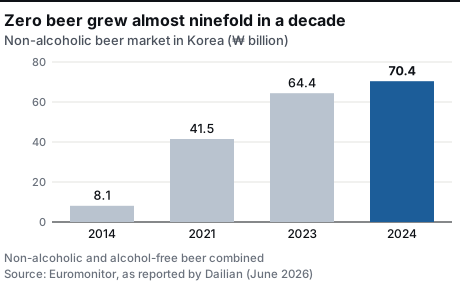
The market numbers show the scale. Euromonitor figures cited in several Korean outlets put non-alcoholic beer sales at ₩8.1 billion in 2014 and ₩70.4 billion in 2024, almost nine times higher. Over the same years, overall drinking slowed: The Fact, citing National Tax Service statistics, reported liquor shipments fell 6.7% between 2019 and 2024.
Sport helps too. The 2026 World Cup, played in North America, put some of Korea’s matches on Korean mornings. On one morning match day in June, CU convenience stores saw non-alcoholic beer sales between 9 a.m. and noon jump 739.4% from the week before, Dailian reported. Chicken and beer before work turned into chicken and zero beer.
For the bigger picture of what Koreans drink now, from lower-proof soju to highballs, read what Seoul is drinking now.
Sources
- Korea Law Information Center — Liquor Tax Act, Article 2 (liquor = 1% alcohol or more)
- Korea Law Information Center — Enforcement Decree of the Liquor License Act (Annex 3: wholesalers may handle non-alcoholic and alcohol-free drinks; Article 12-2 added May 28, 2024)
- Korea Law Information Center — Road Traffic Act, Article 44(4) (0.03% blood alcohol limit)
- Korea.kr (Ministry of Food and Drug Safety) — Non-alcoholic vs alcohol-free: what's the difference? (August 2022)
- Ministry of Food and Drug Safety — Food Labeling Standards revision, Notice 2021-88 (November 2021)
- Opensurvey — MZ Generation Alcohol Trend Report 2026 (September 7, 2026)
- Asia Economy — Liquor license decree amendment takes effect (May 28, 2024)
- Segye Ilbo — How to read non-alcoholic labels; MFDS test thresholds (June 13, 2026)
- The Fact — 0.0% or 0.00%? (March 15, 2025)
- YTN — Korea Consumer Agency survey on zero labels (May 10, 2024)
- Dailian — World Cup and non-alcoholic beer; Euromonitor market size (June 17, 2026)
- The Fact — Morning World Cup matches and zero beer; NTS shipment data (June 23, 2026)
- Jaekyung Ilbo — emart24 early-July 2026 sales (July 10, 2026)
- Hankyung — Non-alcoholic beer market share; Hite Zero 0.00, Cass All Zero, Terra Zero (June 3, 2026)
- Money Today — Terra Zero bottles and Cass Lemon Squeeze Zero (July 17, 2026)
- Tax Times — Cass Zero relaunched at 0.00% (May 27, 2026)
- Digital Daily — Hite Non-Alcoholic 0.7% repackaged (January 14, 2026)
- Herald Corporation — Kloud Non-Alcoholic (June 17, 2026) · convenience store non-alcoholic sales and Zen Highball (October 17, 2025)
- Wikitree — Heineken 0.0 (July 2021) · Etoday — Guinness 0.0 in Korea (July 2024)
- Kyunghyang Shinmun — Sober curious and healthy pleasure (April 21, 2026)