 Seoul Window
The short answer
- Physical K-pop album sales in Korea peaked in 2023, then fell 19.5% in 2024 and 7.4% in 2025 (Circle Chart Top 400).
- Album exports rose anyway, passing US$300 million for the first time in 2025 at US$301.74 million. The first half of 2026 alone brought in US$257.48 million, up 125% (Korea Customs Service).
- Fan money is shifting from albums to concerts and merch. In the first half of 2026, 34.3% of HYBE's revenue came from concerts and 20.9% from merchandise and licensing (DART filing).
- Fan apps are a business too. Bubble's operator DearU made ₩83.8 billion in 2025, charging US$4.49 per artist per month overseas.
No official survey tells you how much K-pop fans spend in a year. But the money leaves a trail at every stop: album sales counts, customs records for album exports, and the revenue that listed entertainment companies report to Korea’s financial regulator.
This piece joins those numbers up, as of October 2026. For what idols personally take home, see how much K-pop idols and Korean actors earn. For which groups are on top, see the most popular K-pop groups in 2026. Here the focus is the fan’s wallet and how big the market behind it has become.
How big is the K-pop industry in 2026?
The four big listed agencies alone took in about ₩5.19 trillion in 2025. That is the sum of 2025 revenue for HYBE, SM, JYP and YG as stated in their 2026 half-year reports on DART, Korea’s electronic disclosure system. The first half of 2026 already adds up to about ₩3.42 trillion, so this year is on track to beat last year.
🏢 Revenue of the four big agencies (DART filings, ₩ billion)
| Company | 2024 | 2025 | H1 2026 |
|---|---|---|---|
| HYBE | 2,255.6 | 2,649.9 | 2,148.3 |
| SM | 989.7 | 1,174.9 | 628.7 |
| JYP | 601.8 | 821.9 | 369.1 |
| YG | 364.9 | 545.4 | 274.9 |
| Total (calculated) | 4,212.0 | 5,192.1 | 3,421.0 |
HYBE’s first-half revenue was up 78.1% on the same period of 2025 (₩1.21 trillion), and in the second quarter it topped ₩1 trillion in a single quarter for the first time, at about ₩1.45 trillion. That is the BTS world tour showing up in the accounts.
Revenue is not profit, though. HYBE’s 2025 operating profit was ₩49.3 billion, an operating margin of just 1.9%. It posted a provisional operating loss of ₩196.6 billion in the first quarter of 2026, then swung back to a ₩170.9 billion profit in the second.
Are K-pop album sales declining?
They fell for two years and are climbing again in 2026. By the count of Circle Chart (formerly Gaon Chart), annual sales passed 100 million for the first time in 2023, then dropped in 2024 for the first time in a decade.
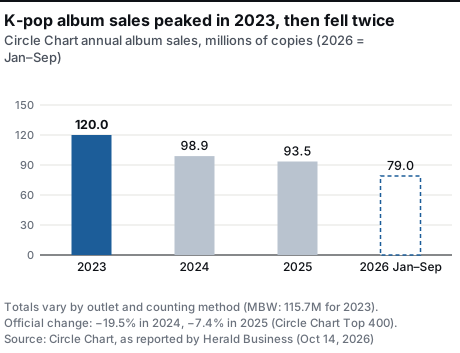
The yearly totals in the chart are the figures Herald Business reported from Circle Chart’s monthly cumulative data. Other outlets give different numbers for the same years (Music Business Worldwide has 115.7 million for 2023 and 93.3 million for 2024) because they add up weeks 1 to 50 instead of calendar months. That is why the cleaner measure is the change Circle Chart itself publishes: −19.5% in 2024 and −7.4% in 2025 for the Top 400.
The 2025 drop was lopsided. In Circle Chart senior researcher Kim Jin-woo’s review of weeks 1 to 50, sales by male artists fell 2.9% while sales by female artists fell 19.9%. Male artists accounted for 74.5% of all album sales. Platform albums, which come as an app download instead of a CD (Weverse Albums, for example), gained 2.3 percentage points of share.
2026 is going the other way. Reports citing Circle Chart data line up like this:
- January to May: about 45.4 million, 2.4 million more than the same months of 2023 (Asia Economy).
- First half: about 55 million, roughly 11 million more than a year earlier (Segye Ilbo). The top seller was BTS’s ARIRANG at 4,224,016 copies (Financial News).
- January to September: about 79 million, about 7.6 million more than a year earlier. If the fourth quarter adds about 21 million, 2026 gets back to 100 million for the first time in three years (Herald Business).
Why do fans buy the same album more than once?
A K-pop album is as much a box of collectibles as a record. Each version comes with a different photo book and a random photocard (포토카드), so fans buy several copies to get the member they want. Entry to a fansign (팬사인회), where fans meet the artists up close, is often tied to album purchases, which pushes numbers up further. Many in the industry read the 2024–2025 decline as this kind of bulk buying cooling off.
Which country buys the most K-pop albums?
The United States, as of the first half of 2026. In Korea Customs Service export data, the US overtook Japan for the first time in the first quarter of 2026 with 28.8% of exports, and it stayed on top for the half year.
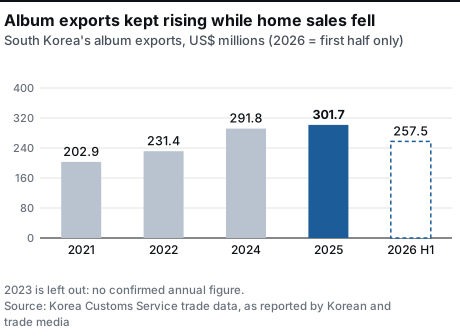
Exports kept growing even in 2024 and 2025, while home sales fell. The 2025 total of US$301.74 million (about ₩444.3 billion) was a record and the first time past US$300 million. Customs figures cited by Music Business Worldwide put 2019 exports at US$74.6 million, so the total has more than quadrupled in six years. The US$257.48 million earned in the first half of 2026 is already about 85% of the 2025 full-year figure.
🌏 Top three markets for album exports (Korea Customs Service, US$ million)
| Rank | Full year 2025 | First half 2026 |
|---|---|---|
| 1 | Japan 80.62 (−10.2%) | United States 74.12 |
| 2 | China 69.72 (+16.6%) | China 61.18 |
| 3 | United States 63.97 | Japan 45.61 |
Places four to ten in 2025 were Taiwan, Germany, Hong Kong, the Netherlands, Canada, France and Poland, according to Maeil Shinmun. In the first quarter of 2026, exports reached US$120 million, the first quarter ever above US$100 million, and went to 131 countries. Exports to North America rose 449.2% and to Europe 397.7% in that quarter, according to Newsis and the Korea Economic Daily.
Is fan money moving from albums to concerts and merch?
The company filings say yes. Revenue that used to center on albums is tilting toward concerts and MD (엠디, official merchandise). HYBE, the biggest of the four, shows it most clearly.
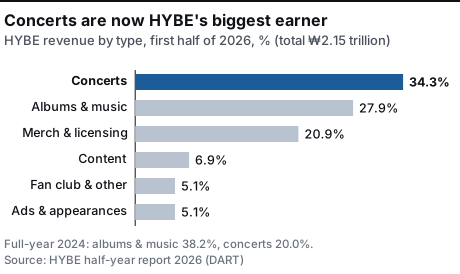
In 2024, albums and music were 38.2% of HYBE’s revenue and concerts 20.0%. In 2025 the two were almost level at 29.2% and 28.8%. In the first half of 2026, concerts (₩736.4 billion) pulled ahead of albums and music (₩598.3 billion). By region, North America brought in 38.6% (₩829.6 billion), more than Korea’s 25.3%.
The other three are heading the same way:
- JYP: merch revenue of ₩104.4 billion beat album revenue of ₩101.7 billion for the first time in the first half of 2026, making up 28.3% of the total (DART).
- YG: concert revenue reached ₩126.4 billion in 2025, the year of BLACKPINK’s world tour, more than seven times the ₩17.0 billion of 2024. With no tour in the first half of 2026, it was ₩40.3 billion (DART). YG reports albums and merch as one line, so merch can’t be split out.
- SM: according to a Kiwoom Securities report, first-quarter 2026 concert revenue rose 56% to ₩60.8 billion while album revenue fell 15% to ₩57.5 billion.
How much do fan apps like Bubble and Weverse make?
Bubble alone brought in ₩83.8 billion in 2025. That figure comes from the half-year report of DearU, the company behind Bubble (버블), the subscription app where artists send fans chat-style messages. First-half 2026 revenue was ₩46.8 billion, 76% of it from outside Korea, and 97% of all revenue comes through app store in-app payments.
💬 Bubble subscription price (one artist, per month, in-app)
| Where you pay | Before | After the 2025 increase |
|---|---|---|
| Korea | ₩4,500 | ₩5,000 |
| Overseas | US$3.99 | US$4.49 |
Subscriptions are per artist, so following several members of one group means paying for each. As of the 2026 half-year report, about 350 K-pop artists and 128 C-pop artists were on the app. The filing does not give a subscriber count.
HYBE’s Weverse doubles as a sales channel for albums, merch and content in the company’s filings. HYBE’s “fan club and other” revenue line was ₩136.4 billion in 2025 (5.1%). HYBE’s report does not give a 2026 monthly user number for Weverse, so we leave it out.
So how much does one fan spend a year?
We could not find an official survey figure we trust. What we can price is the pieces. A year of Bubble for one member costs US$53.88 at the overseas rate (US$4.49 × 12) or ₩60,000 in Korea, and albums, merch and concerts come on top. For ticket prices and how to book, see how to get concert and musical tickets in Seoul.
What can you actually do in Seoul?
The easiest way to see these numbers in real life is in album shops, merch stores and agency pop-ups.
- Albums and merch: record shops and photocard traders in Myeongdong, Hongdae, Seongsu, Insadong and COEX, agency stores such as SM’s KWANGYA@SEOUL in Seongsu and YG’s the SameE in Insadong, plus tax refund rules, are all in the Seoul K-pop album and merch shopping guide, sorted by neighborhood.
- HYBE pop-ups in Yongsan: since March 2026, HYBE has used the ground-floor lobby of its Yongsan headquarters for artist pop-ups (the first was BTS’s ‘ARIRANG’, March 20 to April 12, according to the Korea Herald). Entry is by Weverse reservation, and the featured artist changes, so check Weverse before you go. This is not HYBE INSIGHT, the museum that closed in January 2023.
📍 Open in Naver Map — HYBE Yongsan building
- Music show recordings: the easiest way to see idols in person during a comeback week. Here is how to attend a K-pop music show.
- Concerts: for booking, see the Seoul concert ticket guide, and for where to stay, hotels near Seoul concert venues.
Practical tip
- If all you want is one member's photocard, look around the photocard trading shops in Hongdae before buying a stack of albums. The shopping guide lists where they are.
- Planning a big merch haul in one store? Check the tax refund conditions first. The shopping guide has the 2026 rules.
Sources
- Circle Chart — Kim Jin-woo, 2025 annual chart review (January 20, 2026)
- Circle Chart — Kim Jin-woo, 2025 album sales review (December 23, 2025)
- Herald Business — January–September 2026 album sales, citing Circle Chart (October 14, 2026)
- allkpop — Circle Chart 2024 year-end data (January 2025)
- Asia Economy — January–May 2026 album sales (July 13, 2026)
- Segye Ilbo — First-half 2026 album sales (July 19, 2026)
- Financial News — Best-selling album of the first half of 2026 (July 10, 2026)
- Music Business Worldwide — 2024 album sales and exports (2025)
- Ilgan Sports — 2021 album exports, citing Korea Customs Service (December 19, 2022)
- Segye Ilbo — 2022 album exports, citing Korea Customs Service (November 26, 2023)
- Maeil Shinmun — Record 2025 album exports, citing Korea Customs Service (January 16, 2026)
- Newsis — First-quarter 2026 album exports (April 28, 2026)
- Korea Economic Daily — First-quarter 2026 album exports by country (April 28, 2026)
- Digital Daily — First-half 2026 album exports (July 17, 2026)
- DART — HYBE half-year report 2026 (August 14, 2026)
- DART — HYBE provisional first-half 2026 results (July 28, 2026)
- DART — SM Entertainment half-year report 2026 (August 14, 2026)
- DART — JYP Entertainment half-year report 2026 (August 14, 2026)
- DART — YG Entertainment half-year report 2026 (August 14, 2026)
- DART — DearU half-year report 2026 (August 14, 2026)
- Kiwoom Securities — Entertainment and leisure second-half outlook (May 27, 2026)
- Kiwoom Securities — SM Entertainment company report (May 11, 2026)
- Korea Herald — HYBE's Yongsan headquarters artist pop-ups (March 23, 2026)