 Seoul Window
The short answer
- Korea Drama Production Association figures put K-drama output (TV + streaming) at 141 titles in 2022, 123 in 2023 and about 100 in 2024 (association estimate). That is a drop of roughly 30%.
- The same association says the average cost per episode went from ₩500–600 million four to five years earlier to ₩1 billion, and up to ₩2 billion, in 2024.
- A Korea Creative Content Agency comparison (September 2023 vs July 2025) found SBS's Thursday slot and the JTBC and ENA Wednesday–Thursday slots gone. tvN was the only channel that kept all its drama slots.
- Studio Dragon, the biggest producer, made 33 dramas in 2022 and 19 in 2025. Its 2026 target is 25 or more.
Open Netflix and it can feel like there are more Korean dramas than ever. The industry’s own numbers say the opposite. Output peaked in 2022 and has fallen since, while the cost of each episode has multiplied. This guide uses figures available as of October 2026 to answer three questions: how many fewer, why, and whether it is turning around. At the end, there’s a drama set near Seoul you can actually walk around, and what to do if you stumble on a shoot in the city.
All won conversions use ₩1,340 to the US dollar (rate of October 28, 2026), so ₩1 billion is about US$750,000.
How many K-dramas are made each year?
About 140 in 2022, falling to around 100 in 2024. But “how many” depends a lot on who is counting. Some counts include only broadcast TV, some add streaming originals, and some go by the year a show was made rather than the year it aired. So instead of picking one number, it helps to see who counted what.
📋 Korean drama counts: who counted, and how (checked October 2026)
| Who counted (reported by) | What was counted | 2022 | 2023 | 2024 | Other years |
|---|---|---|---|---|---|
| Korea Drama Production Association (News1, Jul 2024) | TV + streaming dramas | 141 | 123 | 105 (Jul 2024 projection) | — |
| Korea Drama Production Association (Dealsite Apr 2024, Invest Chosun Sep 2025) | Same association, different reports | 135 | 125 / 123 | about 100 (estimate) | — |
| Daishin Securities (Media Today, Jan 2026) | Broker’s own count, with episodes | — | — | 80 (1,007 eps) | 2025: 85; 2026: 104 (forecast) |
| Korea Communications Commission market review (Weekly Donga, May 2025) | Korean broadcasters’ dramas only | — | — | 77 | 2019: 109 |
| Prof. Cho Young-shin, Dongguk University (Segye Ilbo, Jul 2026) | Expert analysis | 136 | — | — | Now: about 110 |
The Korea Communications Commission figures add one more detail: Korean originals made for global streamers went from 3 in 2019 to 22 in 2024. Streaming filled part of the gap broadcasters left, but not all of it.
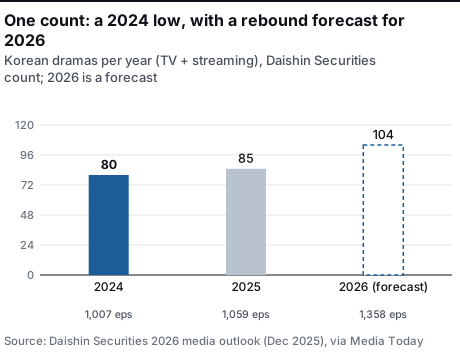
The chart uses only the Daishin Securities series, because it was counted the same way each year. On that count 2024 was the low at 80 dramas, and the 2026 forecast of 104 would be about 30% above it. It is not mixed with the association series because the two use different rules.
Why are there fewer K-dramas now?
Costs multiplied, and neither TV networks nor streamers were willing to keep paying for as many shows. In order, it went like this:
- The 2021–22 streaming land grab. Netflix, Disney+, TVING and Wavve all ordered heavily to win subscribers, and actor fees and crew pay rose with them. That’s why output peaked in 2022. In 2023 Netflix announced it would invest US$2.5 billion in Korean content over four years.
- Streamers tightening up from 2023. The Fact reported that TVING lost ₩142 billion and Wavve ₩79.1 billion in operating terms in 2023. Hankyung and Weekly Donga relayed industry accounts that the margin Netflix guarantees producers fell from as much as 20% two to three years earlier to 5–7%.
- Broadcasters earning less. As ad money moved online, Korean broadcasting revenue fell for a second year to ₩18.8 trillion in 2024 and operating profit dropped 26.7%, according to Korea Communications Commission data cited in a Korea IR Council report.
- Longer shoots. After Korea’s 52-hour work week, filming a 16-episode drama went from 100–120 days to about 180, The Fact reported, citing industry sources. More days means more wages.
The result is a split. Big shows got bigger, and the mid-budget drama made for a few hundred million won an episode largely disappeared. As of January 2024, the production association said nearly 20 finished dramas were sitting unaired, tying up about ₩300 billion (reported by Xportsnews). Prof. Cho argues Korea needs about 120 dramas a year to keep a healthy range of genres.
How much does a K-drama cost per episode?
About ₩1 billion (around US$750,000) on average in 2024, and up to ₩2 billion, according to the Korea Drama Production Association. Bae Dae-sik, the association’s secretary general, told News1 in July 2024 that the average had been ₩500–600 million four to five years earlier and ₩600–700 million during the pandemic (2020–21). Include the blockbusters and the average climbs. Herald Business put 2024’s average in the ₩3 billion range, and Prof. Cho estimated a roughly sixfold jump from ₩550 million in 2018 to ₩3.5 billion in 2024. Invest Chosun put the 2025 average at about ₩2 billion, comparing it with about ₩1 billion an episode in Japan.
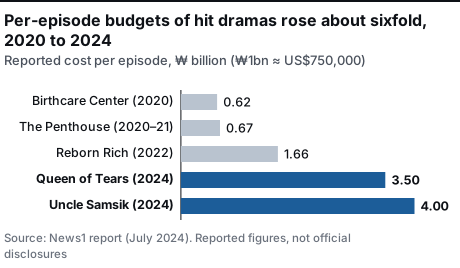
Divide the budgets News1 listed by episode count and the jump is plain: hit dramas that cost around ₩600 million an episode in 2020 cost ₩3.5–4 billion (about US$2.6–3 million) by 2024. That’s roughly six times as much in four years.
💰 Biggest reported K-drama budgets (press reports, not official figures)
| Drama (platform, year) | Reported total budget | Episodes | Reported by |
|---|---|---|---|
| Tempest (Disney+, 2025) | about ₩70bn (promoted as “the biggest ever”) | — | Invest Chosun, Cine21 |
| Gyeongseong Creature seasons 1+2 (Netflix) | ₩70bn | 17 | News1 |
| Moving (Disney+, 2023) | about ₩65bn | 20 | Newsis |
| When Life Gives You Tangerines (Netflix, 2025) | ₩50–60bn (outlets differ) | 16 | Invest Chosun, Cine21 |
| Queen of Tears (tvN, 2024) | ₩56bn | 16 | News1 |
| Uncle Samsik (Disney+, 2024) | ₩40bn | 10 | News1 |
| Narco-Saints (Netflix, 2022) | about ₩35bn (₩5.8bn per episode) | 6 | Hankyung |
| Reborn Rich (JTBC, 2022) | ₩26.48bn | 16 | News1 |
For scale, ₩70 billion is about US$52 million. Netflix and Disney+ do not disclose per-title budgets; when Newsis reported the Moving figure, Disney Korea said it could not share the number. Treat these as reported estimates.
How much do Korean actors get paid per episode?
There’s no official data, but leads in reported cases get roughly ₩300–500 million an episode. Hankyung reported that cast fees make up 40–60% of a drama’s budget (20–30% for films), which is the single biggest reason per-episode costs climbed.
- Herald Business (October 2024), quoting industry sources, said ₩300–400 million an episode is “standard” for a lead.
- At a production association meeting in January 2024, producers cited actual asks of ₩400 million, ₩650 million and ₩700 million an episode, and one remark was that ₩1 billion an episode had become a real conversation (Xportsnews).
- The Fact (May 2024) reported a lead who earned about ₩100 million an episode on broadcast TV getting about ₩500 million on a streaming show, after which ₩500 million became the benchmark. Supporting actors saw ₩4 million on TV versus ₩15 million on streaming.
- Invest Chosun (September 2025) reported that the two leads of When Life Gives You Tangerines were each paid about ₩500 million an episode.
Background: why is there no pay cap?
At the January 2024 meeting, the production association agreed a pay guideline was urgently needed but did not announce a cap. On February 6, 2024, Culture Minister Yu In-chon said it would be hard for the government to set one and left it to the industry (reported by The Fact). For comparison, China's 2022 rules cap total cast pay at 40% of a budget, with leads getting no more than 70% of that.
For who’s in demand right now, see the most popular Korean actors of 2026 by the numbers.
Why are K-dramas only 12 episodes now?
Per-episode costs went up, so producers cut episodes to keep the total budget in check. Sixteen episodes was the standard through the 2010s. According to MTN, of the 11 TV dramas airing in January 2025 (excluding daily soaps), six had 12 episodes and only three had 16. Streaming originals often run 6 to 10.
The bigger cut was in 편성 (pyeonseong, the broadcast schedule) slots. In its Broadcast & OTT Trends 2025 Vol. 3, the Korea Creative Content Agency (KOCCA) compared first-run drama schedules in September 2023 and July 2025:
- Network TV: SBS’s Thursday drama slot was gone. SBS ran only its Friday–Saturday slot.
- General cable channels: TV Chosun, Channel A and MBN, which had run drama slots on and off, had none in 2025. JTBC dropped its Wednesday–Thursday drama.
- ENA also dropped its Wednesday–Thursday slot. tvN was the only channel that kept its existing slots.
- Reruns and bought-in shows filled the gaps. KBS2 aired Dear.M as a summer special after it had already run on KBS Joy, and MBC put the 2022 Disney+ series Big Bet (Casino) into its Friday–Saturday slot.
The same report lists average drama 시청률 (sicheongnyul, TV ratings) on the networks from March 2024 to March 2025 (Nielsen Korea): KBS1 12.3%, SBS 8.43%, KBS2 7.57% and MBC 6.08%. Variety, documentary and current-affairs shows averaged 2% or less. Drama is still the most-watched genre on Korean TV, and slots are shrinking anyway. That tells you most of what you need to know. For what Koreans actually watch, see what Koreans watch on streaming and TV.
Are more K-dramas coming in 2026?
Yes, the signs point up, but slowly. The clearest first-hand numbers come from Studio Dragon, Korea’s largest drama producer and the company behind Queen of Tears.
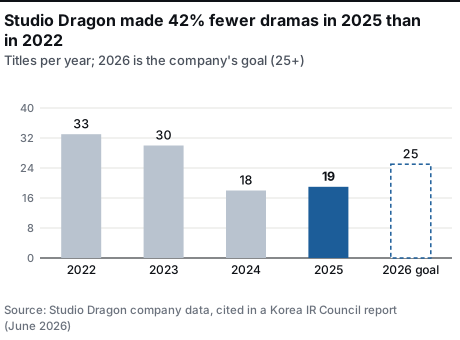
Studio Dragon made 19 dramas in 2025, 42% fewer than the 33 it made in 2022. Revenue fell from ₩753.1 billion in 2023 to ₩550.1 billion in 2024 (−27.0%) and ₩530.7 billion in 2025 (−3.5%). Look at where the money came from, though. In 2025 overseas revenue was ₩335.5 billion (+3.3%), well above domestic revenue of ₩195.2 billion (−13.4%), and in Q4 40 of its 46 new TV episodes were pre-sold to global streamers. More and more, a Korean drama is made on the assumption it will sell abroad.
What points to 2026 being better:
- Studio Dragon said its slate includes 10+ titles for tvN plus dramas for KBS, MBC and SBS, resuming supply to all three networks (February 5, 2026). Its target, as reported by the Korea IR Council, is 25 or more titles.
- According to a Samsung Securities report, Studio Dragon aired 91 episodes in Q1 2026, its biggest quarter on record.
- Daishin Securities forecasts 104 dramas (1,358 episodes) industry-wide in 2026. Sidae (April 2026) relayed a forecast of “about 100”, so the real number won’t be known until the year is over.
- tvN brought back its Wednesday–Thursday drama in February 2026 after stopping it in mid-2023, but Samsung Securities said the slot was paused again as of May and called the recovery slow.
Background: why isn't there one official number?
We could not find an official government statistic that cleanly reports the number of Korean dramas per year. Association figures have reached the public through news reports in slightly different versions (141 or 135 for 2022), and brokers run their own counts for investors. That's why this guide shows the numbers side by side with their sources instead of picking one.
What you can do in Seoul: drama sets and live shoots
The big historical-drama set is in Yongin, just outside Seoul, and in the city itself you may walk into a street shoot.
MBC Yongin Daejanggeum Park
MBC’s open-air set for 사극 (sageuk, historical dramas). You can walk through palace and market-street sets, and SUGA (Agust D) of BTS filmed his “Daechwita” video here (see BTS places in and around Seoul). The details below were checked on the official website on October 29, 2026.
- Address: 25 Yongcheondeurama-gil, Baegam-myeon, Cheoin-gu, Yongin, Gyeonggi-do · Tel +82-2-789-1675
- Hours: March–October 09:00–18:00, November–February 09:00–17:00. Last entry one hour before closing. Closed on Seollal (Lunar New Year’s Day); open 10:00–18:00 on Chuseok day.
- Admission: adults ₩11,000, teens and children ₩9,000, preschoolers free. ₩2,000 off for groups of 20+, visitors 65 and over, and some other groups.
- Good to know: the official notice says some sets may be closed while a drama is filming. No pets except guide and assistance dogs. The park posts temporary closures from time to time, so check the news page before you go.
Practical tip: getting there from Seoul
- Public transport (official route): Giheung Station (Suin-Bundang Line) → transfer to the Yongin EverLine → get off at Stadium–Songdam College → bus bound for Baegam from the Forbes Hospital stop → from Baegam, bus 105 (Kyungnam Yeogaek, 10 runs a day) or a taxi.
- With all the transfers and a bus that runs only 10 times a day, budget at least half a day. If there are two or more of you, a car or a tour is much easier.
- By car: Gyeongbu Expressway to Singal IC → Yeongdong Expressway (toward Hobeop) → Yangji IC → toward Baegam.
- From November, it closes at 17:00, so the last entry is 16:00.
Farther afield there are large sets such as the Mungyeong Saejae Open Set in North Gyeongsang and Hapcheon Movie Theme Park in South Gyeongsang. We could not confirm their current hours and prices from official sources, so check each official site to make sure they’re open before you plan a trip.
If you come across a K-drama shoot in Seoul
Commercial filming in Seoul needs approval from the Seoul Film Commission, and the Seoul Facilities Corporation advises applying 14 days ahead. Shoots at its facilities cluster in April and November (23 and 20 shoots in 2025), so late autumn, like now, is when you’re most likely to see one.
- If staff have taped off an area or ask you to wait, go along with it. It’s often over in a few minutes.
- Filming a scene in progress and posting it online can raise copyright problems.
- Posting photos where actors or passers-by can be identified, without their consent, can breach 초상권 (chosanggwon, portrait rights). Korea’s Supreme Court ruled on April 29, 2021 (2020da227455) that being in a public place does not by itself make it acceptable. More in filming strangers in Korea and portrait rights.
For routes and etiquette at the locations themselves, see our K-drama filming locations in Seoul guide.
K-entertainment by the numbers
Sources
- CJ Newsroom — Studio Dragon Q4 and full-year 2025 results (February 5, 2026, Korean)
- Korea IR Council Research Center — Studio Dragon report (June 30, 2026, Korean)
- Samsung Securities — Studio Dragon report (May 2026, Korean)
- Korea Creative Content Agency — Broadcast & OTT Trends 2025 Vol. 3: drama slots and ratings by genre (August 2025, Korean)
- News1 — Korea Drama Production Association data on drama counts and budgets (July 13, 2024, Korean)
- Dealsite — Drama counts and per-episode costs (April 26, 2024, Korean)
- Invest Chosun — Drama budgets and actor fees (September 16, 2025, Korean)
- Media Today — Daishin Securities 2026 media outlook (January 10, 2026, Korean)
- Weekly Donga — Korea Communications Commission broadcast market review (May 26, 2025, Korean)
- Segye Ilbo — Analysis by Prof. Cho Young-shin (July 2026, Korean)
- Digital Daily — Prof. Cho Young-shin seminar presentation (September 12, 2026, Korean)
- Herald Business — Per-episode budgets and actor fees (October 28, 2024, Korean)
- Hankyung — Drama budgets and producers' results (May 1, 2025, Korean)
- Xportsnews — Korea Drama Production Association meeting (January 2024, Korean)
- The Fact — Streaming-era actor fees and shooting days (May 14, 2024, Korean)
- The Fact — Debate over capping actor fees (February 9, 2024, Korean)
- Newsis — The budget of Moving (September 24, 2023, Korean)
- Cine21 — 2025 drama year in review (December 26, 2025, Korean)
- MTN — The rise of 12-episode dramas (January 23, 2025, Korean)
- Sidae — 2026 drama output outlook (April 9, 2026, Korean)
- MBC Yongin Daejanggeum Park — Admission, hours and directions (checked October 29, 2026, Korean)