 Seoul Window
If you are struggling right now
This article looks at mental health in Korea through statistics. If things feel very heavy for you right now, please reach out before you keep reading. In Korea you can talk to someone straight away at 109 (suicide prevention line, 24 hours) or 1577-0199 (mental health crisis line, 24 hours). If Korean is hard for you, call 1577-1366 (Danuri Call Center, 13 languages) and ask for an interpreter. If a life is in danger, call 119. If you are outside Korea, contact your local crisis line or emergency number.
The short answer
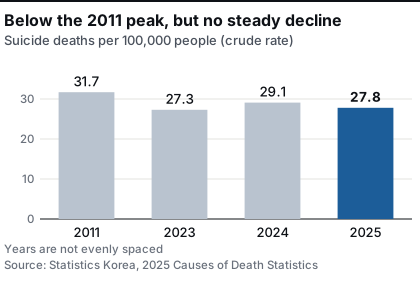
- South Korea's suicide rate in 2025 was 27.8 per 100,000 people (14,144 deaths), the first drop in three years. Adjusted to the OECD standard population it is 24.9, still the highest of any member country and about 2.3 times the OECD average of 10.9 (Statistics Korea).
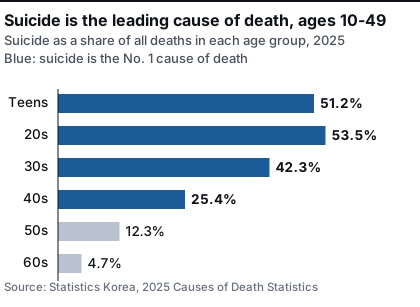
- The most worrying change is among teenagers. The teen suicide rate was the only one to rise in 2025, hitting a record high, and suicide is the leading cause of death from the teens through the 40s.
- More people are struggling, but relatively few get treatment. The number of people treated for depression grew about 36% in five years, and surveys suggest more than one in four adults will face a mental health condition at some point in their life.
- If you need help in Korea: 109 (suicide prevention), 1577-0199 (mental health crisis), and 1577-1366 if you need an interpreter.
Spend a few days in Seoul and the city always looks busy. Cram-school streets lit up late into the night, office workers boarding the first train before dawn, queues outside dessert shops, glittering malls. But there is another side that Koreans talk about a lot among themselves: “highest suicide rate in the OECD”, “burnout”, “Hell Joseon”. It is also one of the questions foreign friends ask most carefully after a trip here. Is life in Korea really that hard?
This article tries to answer that with official statistics rather than impressions. Most numbers come from Statistics Korea, the Ministry of Health and Welfare, the National Center for Mental Health and the Health Insurance Review and Assessment Service. Surveys use different reference years, so each table and chart shows its year. Individual cases and methods are not discussed here.
Does South Korea really have the highest suicide rate in the OECD?
Yes. As of 2025 it is still the highest among OECD member countries. When reading the numbers, though, it helps to separate two figures: the crude rate Korea uses domestically (based on the actual population) and the OECD age-standardized rate, which adjusts for age structure so countries can be compared.
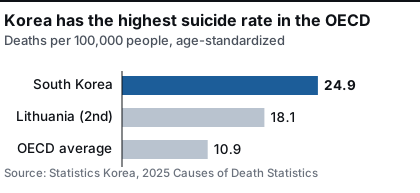
Korea’s rate is 6.8 points higher than second-placed Lithuania and about 2.3 times the OECD average.
Over the long run, Korea’s suicide rate peaked at 31.7 per 100,000 in 2011, came down, and has recently been moving up and down again.
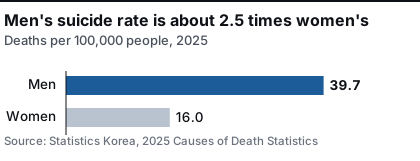
The gap between men and women is large too. In 2025 the suicide rate was 39.7 per 100,000 for men and 16.0 for women, so men’s rate is about 2.5 times higher. Among teenagers, however, the rate is higher for girls; men’s rate overtakes from the 20s onward.
Which age group is most at risk in Korea?
Young people if you look at suicide’s share of all deaths; older men if you look at the rate per population. Because the two measures point in different directions, Korea’s suicide problem cannot be explained by a single cause.
- Teens: In 2025 the teen suicide rate was 8.6 per 100,000, up 7.5% from the year before. It was the only age group to rise, more than double the 2015 figure (4.2), and the highest since records began in 1983.
- People in their 40s: The rate for people in their 40s was 34.3, the second highest on record after 2024 (36.2), and suicide was the leading cause of death for this age group for the second year running.
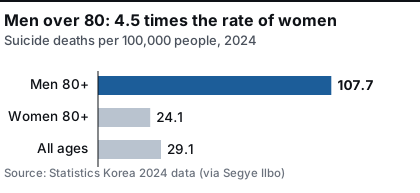
- Older men: Their share looks small, but their rate per population is the highest. In 2024, men aged 80 and over had a suicide rate of 107.7 per 100,000, about 4.5 times that of women the same age (24.1) and about 3.7 times the overall average.
What do the numbers say about mental health in Korea?
Many people say they are struggling, and few get treatment. That is Korea’s mental health data in one sentence.
🧠 Key mental health indicators in Korea (reference years vary by survey)
| Indicator | Figure | Source (year) |
|---|---|---|
| Lifetime prevalence of mental disorders | 27.8% | National Mental Health Survey (2021) |
| One-year prevalence of depressive disorders | 1.7% | National Mental Health Survey (2021) |
| One-year prevalence of anxiety disorders | 3.1% | National Mental Health Survey (2021) |
| People with a depressive disorder who used treatment or services within a year | 28.2% | National Mental Health Survey (2021) |
| Extreme stress in the past year | 46.3% (36% in 2022) | National Center for Mental Health (2024) |
| Low mood lasting several days or more | 40.2% (30% in 2022) | National Center for Mental Health (2024) |
| People in their 20s among those treated for depression | 206,629 (18.2%, the largest age group) | HIRA (2025) |
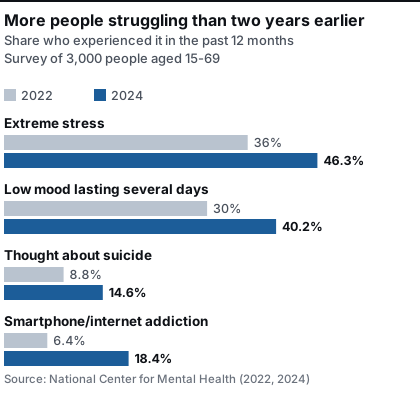
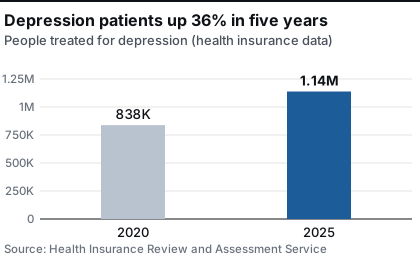
There is a reason the numbers seem to disagree. “Depressive disorder” measured strictly against diagnostic criteria (1.7%) and the share of people who say they “felt low for several days” (40.2%) are measuring different things. The rise in depression treatment is not necessarily a bad sign, either. Many observers read it as the barrier to psychiatric care getting lower, so people who once would have quietly endured are now seeing a doctor.
Stigma: a barrier that is still high
In the 2024 National Center for Mental Health survey, people who had a mental health problem turned for help to family and relatives (49.4%), medical professionals (44.2%) and friends (41%), in that order. More than 90% agreed that “anyone can develop a mental illness”, yet 50.7% said “some of my friends would distance themselves if I had a mental illness”, up from 39.4% in 2022. And 64.6% believed “people with mental illness are more dangerous”. A long-standing worry that a psychiatric record could count against you in hiring or insurance is also often cited as part of the barrier.
Hwabyung, an illness with a Korean name
Hwabyung (火病) refers to symptoms believed to come from long-suppressed feelings of injustice and anger. Hwa (火) means fire and byung (病) means illness, so it is literally "fire illness", the feeling of a fire burning inside. It is marked by physical symptoms: tightness in the chest, heat rising up through the body, trouble sleeping, frequent sighing. It is famous for being listed in the American Psychiatric Association's diagnostic manual, DSM-IV, as a culture-bound syndrome specific to Korea. It has traditionally been associated with middle-aged and older women, and in clinical practice it often appears alongside depressive and anxiety disorders.
Why is life in Korea so stressful?
There is no single cause. Here are the background factors that government reports and researchers commonly point to, with numbers. These indicators are not direct causes of suicide; read them as a guide to where pressure builds up in Korean society.
📊 Indicators of pressure in Korean society
| Area | Indicator | Figure | Source |
|---|---|---|---|
| Life satisfaction | Rank among 38 OECD countries | 33rd (6.04 points, OECD average 6.50) | Statistics Korea, Quality of Life in Korea 2025 |
| Happiness | World Happiness Report 2026 | 67th (6.040 points) | World Happiness Report |
| Old-age poverty | Relative poverty rate, age 66+ | 39.8% (4 in 10) | Statistics Korea, Quality of Life in Korea 2025 |
| Work | Average annual working hours (2025) | 1,833 hours (97 more than the OECD average, 6th longest) | Media reports citing OECD data |
| Social ties | Participation in social groups (2024) | 52.3% (down 5.9 points from the year before) | Statistics Korea, Quality of Life in Korea 2025 |
- Exams and jobs: Competitive pressure on teens and people in their 20s is the most frequently mentioned factor in Korea. In a 2024 youth survey, young people who mostly stay at home named “difficulty finding a job” (32.8%) as the biggest reason for their isolation.
- Poverty and loneliness in old age: The fact that 4 in 10 people aged 66 and over live in relative poverty is often mentioned alongside the high suicide rate among older men.
- A culture of enduring, and stigma: It is hard to say out loud that you are struggling, and a tendency to hide psychiatric visits delays help.
- Rapid change: Another explanation is that family structures and communities changed very fast as Korea went from a poor country to a wealthy one within a single generation.
How common are lonely deaths and isolated youth in Korea?
Lonely deaths are rising every year, and more young people rarely leave home. Korean even has its own words for these.
- Godoksa (lonely death): a death that happens alone, cut off from family and friends, and is discovered only after some time has passed. In the Ministry of Health and Welfare survey there were 3,924 lonely deaths in 2024, up 7.2% from 3,661 the year before. Men made up 81.7%, more than five times the number of women, and people in their 50s and 60s accounted for around 60%. The share found in studio apartments and officetels rose sharply, from 4.0% in 2020 to 19.6% in 2024.
- Isolated and reclusive youth: In the 2024 Survey on the Lives of Young People (Office for Government Policy Coordination), 5.2% of all young people said they “mostly stay at home”, and 0.9% said they never go out at all. That is more than double the figures from the survey two years earlier.
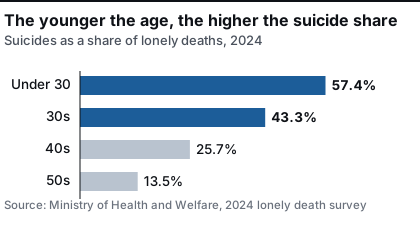
The younger the person, the larger the share of lonely deaths that are suicides. That is read as a sign that isolation among young people living alone is about more than lifestyle.
How is South Korea responding?
By bringing helplines together, paying for counseling and lowering the barrier to care.
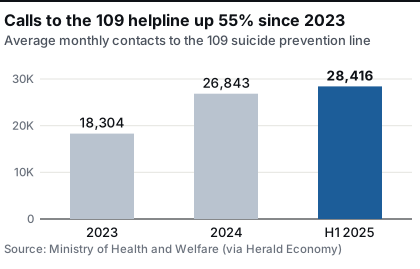
- The 109 suicide prevention line (January 2024): Helplines that used to be spread across several numbers, including 1393, were merged into one three-digit number. Average monthly contacts rose from 18,304 in 2023 to 26,843 in 2024 and 28,416 in the first half of 2025. In October 2025 a second counseling center opened, bringing the number of counselors to 140.
- National Mental Health Investment Support Program (from July 2024): People referred as needing counseling for depression, anxiety and similar problems get a voucher for eight one-on-one sessions with a professional counselor. Each session is valued at ₩70,000–80,000, and the personal copay is 0–30% depending on income. Whether foreign residents are eligible should be checked with the local government.
- A shift among younger Koreans: The fact that people in their 20s are the largest group treated for depression can also be read the other way: younger Koreans are starting to see a psychiatrist’s office not as “somewhere shameful” but as “somewhere you go when you need to”.
Where can foreigners get mental health help in Korea?
In an emergency call 119; for counseling, 109 and 1577-0199; if Korean is difficult, ask 1577-1366 for an interpreter. Whether you are a traveler or a student, you can use these numbers while you are in Korea.
📞 Crisis and counseling numbers in Korea (as of October 2026)
| Number | What it is for | Hours | Languages |
|---|---|---|---|
| 119 | Ambulance and emergencies | 24 hours | Korean (interpreting can be connected) |
| 112 | Police, immediate danger | 24 hours | Korean (interpreting can be connected) |
| 109 | Suicide prevention line | 24 hours | Mainly Korean |
| 1577-0199 | Mental health crisis line (linked to local mental health welfare centers) | 24 hours | Mainly Korean |
| 1577-1366 | Danuri Call Center (support for multicultural families and migrants, three-way interpreting) | 24 hours | 13 languages |
Practical tips: seeing a mental health professional in Korea
- Many neighborhood psychiatry clinics (jeongsingeongang-uihakgwa) see patients without an appointment, and fees are modest if you are enrolled in national health insurance. Short-term travelers without insurance pay uninsured rates, so ask about the cost before your consultation.
- If you need care in English, the international healthcare centers at large university hospitals can help you book. Whether English-language psychiatric care is available varies by hospital, so check first.
- Check your travel insurance policy to see whether mental health care is covered.
- If a Korean friend seems to be having a hard time, a simple "How have you been lately?" matters more than solutions. If they seem to be in danger, do not carry it alone; call 109 together.
What sits behind the numbers
The numbers in this article are heavy, but they are not here to label Korea a “depressed country”. The same statistics also contain numbers that went down. The suicide rate fell in 2025 for the first time in three years, and the share of people who have ever thought about suicide dropped 3.8 points over five years. More people calling helplines also means people who could not speak up before are starting to. Seoul’s bright streets and these numbers are two faces of the same city, and knowing both is how you understand this country a little more accurately.
If you are curious about other sides of Korean society, read our guides to Korean MZ slang and the Trend Korea 2027 keywords. They show from a different angle how Koreans see work and life today.
Once more, if you need help
In Korea: 109 (suicide prevention, 24 hours) · 1577-0199 (mental health crisis line, 24 hours) · 1577-1366 (Danuri Call Center, 13 languages) · emergencies 119. If you are outside Korea, contact the crisis line or emergency number in the country where you are.
Sources
- Suicide statistics: Statistics Korea, 2025 Causes of Death Statistics briefing (Korea.kr, 2026-09-22, in Korean), MTN (2026-09-23, in Korean), iNews24 (in Korean), Asia Economy (in Korean)
- Suicide rates for men and women aged 80+ (2024): Segye Ilbo (2026-03-09, in Korean)
- National Mental Health Survey 2021: Prevalence of Mental Disorders and Associated Factors in Korean Adults: National Mental Health Survey of Korea 2021
- National Center for Mental Health 2024 survey: The Korea Times (2024-07-04)
- People treated for depression: Newsis (HIRA statistics, 2026-08-01, in Korean)
- National suicide survey 2023: Ministry of Health and Welfare press release (Korea.kr, in Korean)
- Lonely deaths: Newsis (Ministry of Health and Welfare 2024 lonely death survey, 2025-11-27, in Korean); isolated and reclusive youth: CBS NoCut News (2025-07-16, in Korean)
- Quality of life and poverty: Korea JoongAng Daily (Statistics Korea, Quality of Life in Korea 2025); World Happiness Report 2026 ranking: Atlas & Boots summary; working hours: Herald Economy (OECD data, in Korean)
- 109 helpline figures: Herald Economy (2025-10, in Korean); Mental Health Investment Support Program: Seoul Metropolitan Government Media Hub (in Korean), Kyungbuk Maeil (in Korean)
- Mental health care guide for foreigners: seoulstart; hwabyung: Wikipedia — Hwa-Byung